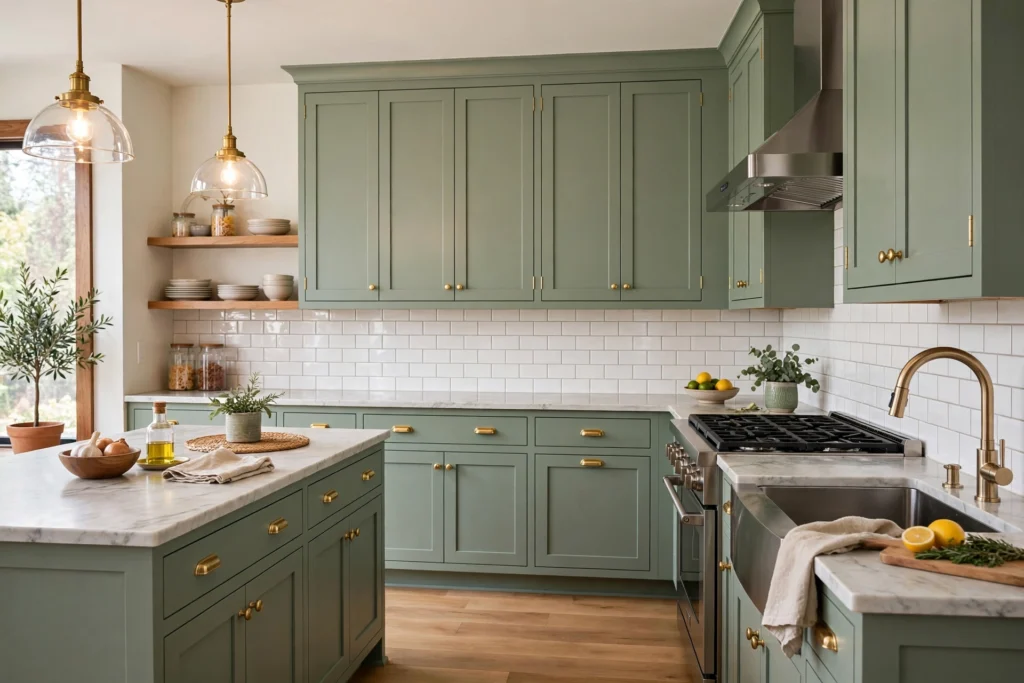
Your cabinets are ugly, but are they bad? That’s the entire question behind every kitchen cabinet remodel, and getting it wrong is how people spend $8,000 refacing cabinets that should have been replaced — or spend $15,000 replacing cabinets that a $600 paint job would have fixed.
Here’s the framework that actually works: you have three real options — paint, reface, or replace — and the right one depends on the condition of your cabinet boxes, your budget, and how long you plan to live there. This guide breaks down the real costs, the honest pros and cons, and how to tell which camp your kitchen falls into.
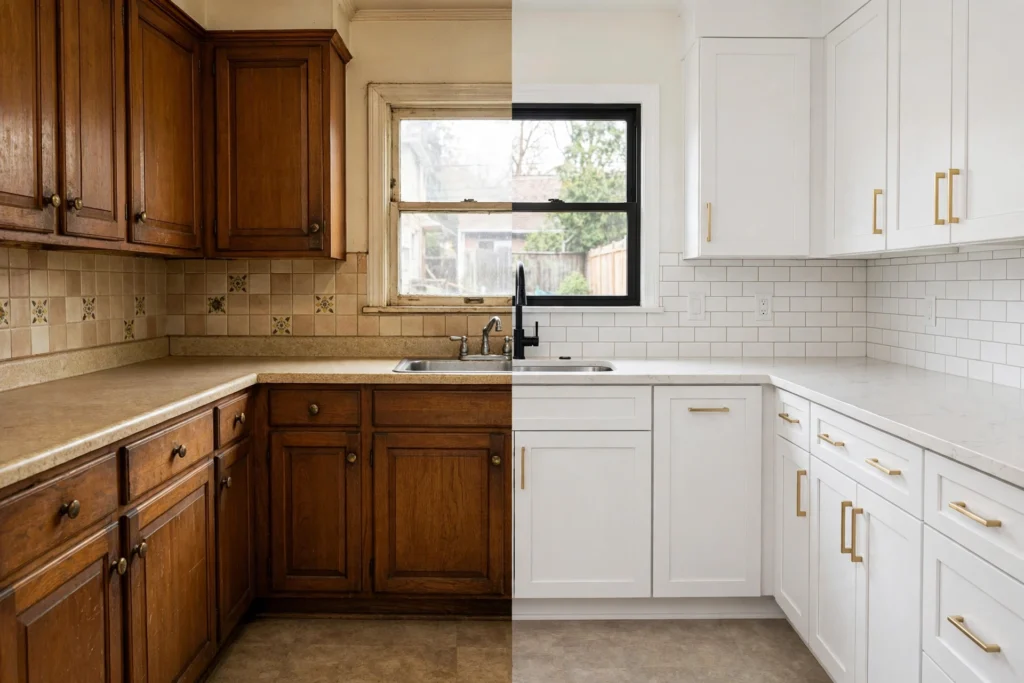
The Three Paths: A Quick Overview
Painting ($300–1,000 DIY / $3,000–10,000 pro): Keep everything, change the color. Cheapest, fastest, biggest visual change per dollar — but it can’t fix bad boxes, bad layout, or worn-out doors.
Refacing ($4,000–12,000): Keep the boxes, replace the doors, drawer fronts, and cover the visible frame surfaces with new veneer. Looks like new cabinets from the outside; the insides stay old.
Replacing ($3,000–25,000+): Tear out and install all-new cabinets. Most expensive, most disruptive, but the only option that fixes layout problems, damaged boxes, and gives you a genuinely new kitchen.
There’s also a fourth option nobody talks about enough: replacing just the doors ($1,500–5,000). New kitchen cabinet doors on solid existing boxes splits the difference between painting and refacing beautifully.
Option 1: Painting Your Kitchen Cabinets
Painting is the highest-ROI move in all of kitchen remodeling. A dated oak kitchen painted in a modern color can look genuinely new for under a thousand dollars if you do it yourself.
What it costs
- DIY: $200–600 for a typical kitchen. You’ll need a gallon or two of bonding primer (Zinsser BIN or STIX), 1–2 gallons of cabinet-grade paint (Benjamin Moore Advance, Sherwin-Williams Emerald Urethane, or Behr Alkyd Enamel), sandpaper, tack cloths, and either good brushes/rollers or a $150–300 HVLP sprayer rental. The sprayer is worth it — brushed cabinets look brushed.
- Professional: $3,000–10,000 depending on kitchen size and your market. A real cabinet painter (not a house painter who “also does cabinets”) removes every door and drawer, sprays them in a shop or sealed booth, and does proper prep. This is worth paying for if you want a factory-looking finish.
When painting is the right call
- The boxes and doors are structurally solid — no warping, no water damage, no peeling veneer
- You like the layout and the door style (or at least don’t hate it)
- The wood is just dated — 90s honey oak is the classic candidate
- Budget is the main constraint
When painting is wrong
- Doors are thermofoil that’s peeling (paint won’t stick to peeling thermofoil, and stripping it is a nightmare)
- Boxes are particleboard that’s swollen from water damage — paint hides nothing structural
- You want a different door style. Paint can’t turn flat 80s doors into Shaker
- Hinges and drawer slides are shot. You can replace hardware during a paint job, but if the boxes themselves are failing, you’re polishing a sinking ship
The honest truth about DIY cabinet painting
It’s 80% prep. Degrease with TSP substitute, sand everything to scuff the surface (120–150 grit), prime with a bonding primer, sand lightly between coats, two topcoats minimum. The whole job takes 4–7 days for a normal kitchen, mostly waiting for paint to dry. And the paint needs 2–3 weeks to fully cure — it’ll feel dry in hours but stays soft enough to dent for weeks. Plan accordingly.
Option 2: Refacing Kitchen Cabinets
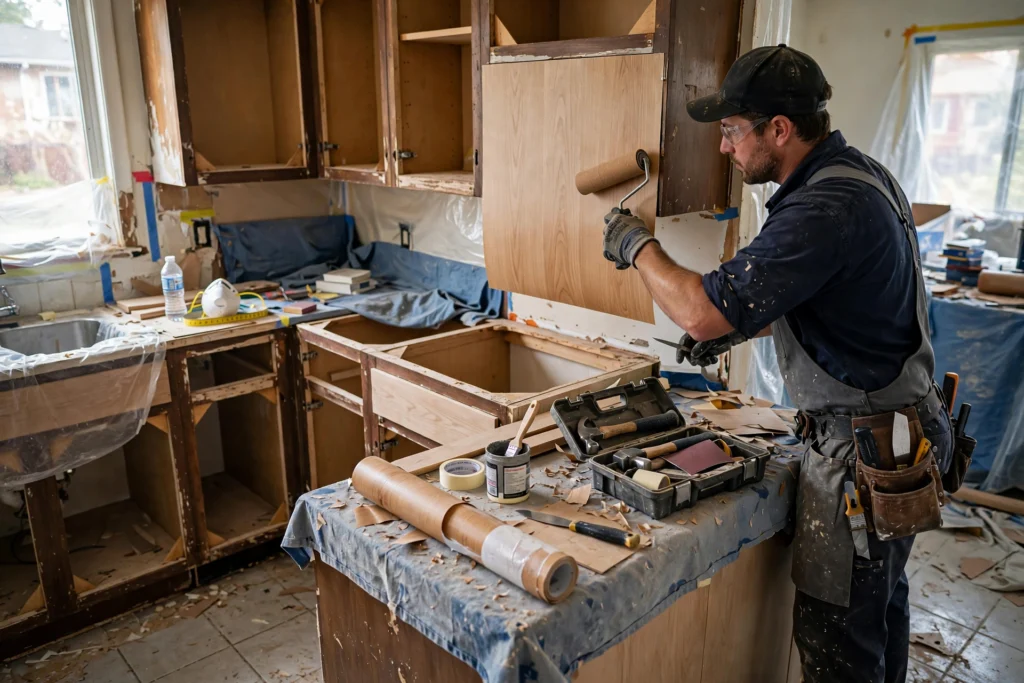
Refacing means stripping your kitchen down to the boxes and making everything visible look new: new doors, new drawer fronts, and the face frames and exposed sides covered in matching veneer or laminate.
What it costs
$4,000–12,000 for a typical 10×10 kitchen, almost always done by a professional refacing company. The price breaks down roughly: 40% materials (doors, veneer, hardware), 60% labor. National franchises (Kitchen Tune-Up, N-Hance, Reborn Cabinets) tend toward the higher end; local refacers are often 20–30% cheaper for the same work.
Per linear foot, expect $150–450. A small galley kitchen might run $4,000–6,000; a large kitchen with an island can push past $12,000.
When refacing makes sense
- The boxes are solid wood or good plywood and perfectly functional
- You like the layout — refacing can’t move a cabinet
- The doors are the problem (dated style, worn finish) but everything behind them works
- You want a new look in 3–5 days with minimal disruption — refacing doesn’t touch plumbing, flooring, or countertops
When refacing is a waste of money
This is the important part, because refacing companies will happily reface anything:
- The boxes are particleboard or low-quality. You’re putting $8,000 worth of new faces on boxes that will fail in five years. Refacing costs 50–70% of full replacement — if the boxes are marginal, put that money toward new cabinets.
- You hate the layout. Refacing locks you into the existing footprint. If you want to move the sink, add an island, or change the configuration, you need replacement.
- You want better storage. Refacing doesn’t add pull-outs, deep drawers, or organizers inside the boxes (though some companies will retrofit a few).
- The cost approaches replacement. Get a quote for new RTA cabinets before you sign a refacing contract. In many markets, new mid-range cabinets installed cost barely more than refacing.
What refacing day looks like
A crew removes all doors, drawers, and hardware, sands and preps the face frames, applies veneer or laminate to every visible frame surface and exposed side, then hangs new doors and drawer fronts with new hinges. Most jobs finish in 3–5 days, and you can usually still use the kitchen (minus doors) during the work.
Option 3: Replacing Kitchen Cabinets Entirely
Full replacement is the nuclear option — and sometimes it’s the only one that makes sense. Out come the old boxes, in go new ones.
What it costs
This is the widest range in remodeling because “new cabinets” spans everything from flat-pack to furniture-grade custom:
- Stock cabinets (Home Depot/Lowe’s): $3,000–8,000 for a 10×10 kitchen, plus $2,000–5,000 installation
- RTA cabinets: $2,500–7,000 for the cabinets, plus assembly and installation (or DIY)
- Semi-custom: $8,000–20,000+
- Custom: $15,000–40,000+
For a full picture of what drives these numbers, see our kitchen cabinets buying guide.
When replacement is the right call
- Water damage, warping, or structural failure in the boxes
- You want to change the layout — move appliances, add an island, reconfigure the footprint
- The cabinets are builder-grade particleboard from the 80s/90s and everything about them is tired
- You’re doing a full kitchen gut anyway (new counters, new flooring, new plumbing) — the incremental cost of new cabinets during a full remodel is much easier to justify
- You’re selling soon and the kitchen is the thing holding the house back (though check with a realtor — sometimes paint is enough)
The disruption is real
A cabinet replacement means 2–4 weeks without a functional kitchen, minimum. You’ll be washing dishes in the bathroom sink and eating takeout. Budget for that — both the money and the sanity. If anyone in the house works from home, plan around the demo noise.
The Fourth Option: New Doors on Old Boxes
If your boxes are solid but your doors are dated, you can buy replacement doors and drawer fronts made to fit your existing cabinets. Companies like Cabinet Doors ‘N’ More and Barker Door will make them to your exact measurements in any style — Shaker, slab, raised panel — finished or unfinished.
Cost: $1,500–5,000 for a full kitchen depending on door style and whether you finish them yourself. Pair new doors with new hinges ($3–6 each for soft-close) and new pulls, and the transformation is dramatic for roughly the cost of a professional paint job.
This is the sweet spot most people miss: it’s cheaper than refacing (no veneer labor on the frames — you paint or stain the frames to match), and it actually changes the door style, which refacing also does but at twice the price.
Cost Comparison: All Options Side by Side
For a standard 10×10 kitchen with 20 linear feet of cabinets:
| Option | DIY Cost | Pro Cost | Timeline | Changes Layout? |
|---|---|---|---|---|
| Paint | $200–600 | $3,000–10,000 | 4–7 days | No |
| New doors only | $1,500–3,000 | $3,000–5,000 | 1–2 weeks | No |
| Reface | N/A (pro only, realistically) | $4,000–12,000 | 3–5 days | No |
| Replace (stock/RTA) | $2,500–7,000 | $5,000–13,000 | 2–4 weeks | Yes |
| Replace (semi-custom) | — | $10,000–25,000 | 4–8 weeks | Yes |
How to Decide: A Practical Walkthrough
Step 1: Inspect your boxes. Open every cabinet. Look for water damage under the sink (the #1 cabinet killer), swollen particleboard, broken drawer boxes, stripped hinge screws, and musty smells. Solid wood or plywood boxes in good shape? You have options. Swollen, crumbling particleboard? You’re replacing, full stop.
Step 2: Be honest about the layout. Stand in your kitchen and ask: if the cabinets were free, would I keep them where they are? If yes, paint/reface/new doors are on the table. If you’ve always hated the corner cabinet situation or the lack of drawer space, no amount of refacing fixes that.
Step 3: Set your budget ceiling. If the number is under $2,000, you’re painting (DIY) or doing doors on a small kitchen. $4,000–8,000 opens up refacing or new stock cabinets. Above $10,000, you’re choosing between refacing and full replacement — and at that point, get quotes for both before deciding.
Step 4: Consider your timeline in the house. Staying 10+ years? Invest in what you’ll enjoy — full replacement with the layout you want. Selling in 2–3 years? Paint or reface; you won’t recoup a $20,000 cabinet job. (Minor kitchen remodels recoup roughly 70–80% at resale; major ones notably less.)
Step 5: Get three quotes. For anything involving a pro — painting, refacing, or replacement — three quotes is the minimum. Refacing quotes in particular vary wildly; I’ve seen $6,000 and $11,000 for the same kitchen from different companies.
Frequently Asked Questions
Is it cheaper to reface or replace kitchen cabinets? Refacing ($4,000–12,000) is usually cheaper than full replacement with comparable quality ($5,000–25,000+), but not by as much as refacing companies imply. Budget stock or RTA replacement often costs about the same as refacing — always get a replacement quote before signing a refacing contract.
Can you reface cabinets yourself? Technically yes — you can buy veneer, doors, and drawer fronts and do it all yourself for $1,500–3,000 in materials. Practically, applying veneer smoothly to face frames is fussy, unforgiving work, and most DIY refacing jobs look DIY. Painting or replacing just the doors are more forgiving DIY paths to a similar result.
How long do refaced cabinets last? A professional reface job lasts 15–20 years — essentially as long as the underlying boxes hold up. That’s the catch: refacing is only as durable as the 20-year-old boxes underneath it. New doors and veneer on solid wood boxes will outlast most of us.
Does painting kitchen cabinets decrease home value? A quality paint job in a current color generally helps resale — buyers respond to clean, modern-looking kitchens. If you’re selling within a year, white, greige, or soft gray are the safe bets; bold colors are a personal choice for a house you’re staying in.
Should I replace cabinets before or after flooring? Cabinets go in before finish flooring in new construction, but in a remodel it depends. If you’re keeping the existing floor, cabinets get replaced around it. If you’re doing both, most contractors install cabinets first, then run flooring up to (not under) the cabinets — it saves material and the flooring stays replaceable. Our kitchen flooring guide covers the sequencing in detail.
Can I keep my countertops when refacing or replacing doors? Yes — refacing and door replacement don’t touch the countertops at all. Full cabinet replacement usually means new countertops too, since old counters rarely survive removal intact and the new layout may differ. That’s a hidden cost of replacement: add $2,000–5,000 for counters if yours can’t be salvaged.