
Here’s something most people don’t realize until they’re mid-remodel: the doors are the kitchen. The boxes behind them are just plywood containers bolted to the wall. When you look at a kitchen, 90% of what you see is doors and drawer fronts — which means changing the doors changes the entire room without touching the plumbing, the layout, or the boxes.
That’s why replacement kitchen cabinet doors are one of the best-kept secrets in home improvement. New doors on solid old boxes can make a 1990s kitchen look brand new for a fraction of a full remodel. But it only works if you understand door styles, materials, sizing, and the difference between replacing doors, refacing, and starting over. This guide covers all of it.
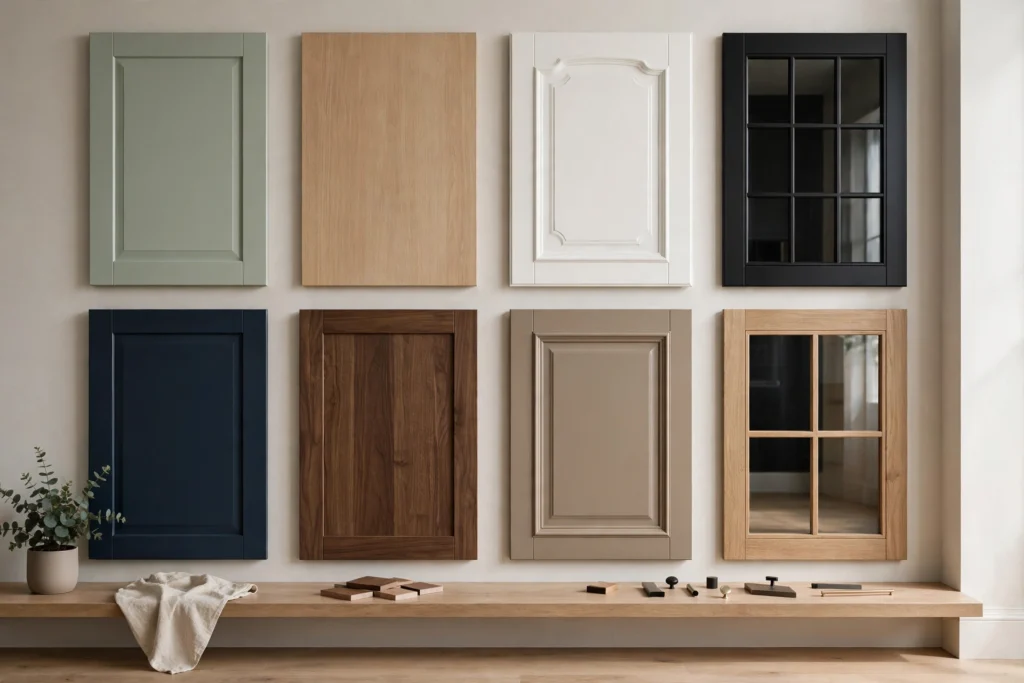
First: What Counts as a “Cabinet Door”?
Quick anatomy lesson, because the terms get mixed up constantly:
- Cabinet door: the hinged panel covering a cabinet opening.
- Drawer front: the decorative panel on the front of a drawer box. It’s not a door, but it’s ordered, finished, and installed the same way — so when people say “replacement kitchen cabinet doors,” they almost always mean doors and drawer fronts together.
- Cabinet front: a general term for doors + drawer fronts as a group.
If you’re ordering “kitchen cabinet doors only” or “cabinet fronts only” from a manufacturer, you’re getting the visible faces — not the boxes, not the hardware (usually), just the fronts.
Kitchen Cabinet Door Styles
Door style is the single biggest design decision. Here’s the full lineup, from most to least popular:
Shaker. A flat center panel framed by a simple square border. Timeless, works in nearly every kitchen style from farmhouse to transitional to lightly modern. If you’re paralyzed by choice, pick Shaker — it’s the safe answer that never looks wrong. I’ve written a whole guide to shaker kitchen cabinets if you want the deep dive on colors, wood options, and costs.
Slab (flat panel). One smooth, flat piece. The modern look — clean, minimal, easy to wipe down. Nothing to catch grease.
Raised panel. The center panel is raised and often has a decorative edge profile. This is the traditional, formal look — think classic suburban kitchens from the 90s and 2000s. It’s fallen out of fashion but still suits colonial and traditional homes.
Recessed/flat panel (mission style). Like Shaker’s cousin — a flat center panel set into a frame, usually with thicker, chunkier rails. Common in craftsman and mission-style homes.
Inset. The door sits flush inside the cabinet frame instead of overlapping it. Gorgeous, precise, furniture-like — and the most expensive construction, because the tolerances are tight. A flat-panel inset door can look surprisingly modern; a beaded inset door is pure traditional.
Glass front. A frame with glass instead of a wood panel. Great for breaking up long runs of solid doors and displaying nice dishes. Frosted or reeded glass hides clutter; clear glass does not — be honest about your dish situation.
Louvered. Horizontal slats like plantation shutters. Allows ventilation (good for laundry or media cabinets) but a nightmare to dust in a kitchen. Rarely the right call near a stove.
Beadboard. Vertical grooves routed into the panel. Cottage and farmhouse kitchens love it. Like louvered doors, the grooves collect grease — fine away from the cooktop, annoying next to it.
My honest take: Shaker for most kitchens, slab for modern ones, and glass fronts as an accent (one or two cabinets, not twelve). Everything else is for specific house styles.
Door Materials: What They’re Made Of
- Solid wood. The premium choice — beautiful, durable, repairable. Cherry, maple, oak, hickory. The downside: wood moves with humidity, which can cause tiny cracks in painted finishes over time (painted wood doors are notorious for hairline cracks at the joints). Stained wood hides this better.
- MDF (medium-density fiberboard). The painted-door champion. Perfectly smooth, doesn’t expand or contract, takes paint beautifully, and costs less than wood. Most “painted” cabinet doors you see are MDF. For a painted finish, MDF is genuinely better than solid wood.
- Plywood. Strong and stable, usually used for slab doors and drawer boxes rather than styled doors.
- Thermofoil. Vinyl heat-shrunk over MDF. Cheap, seamless, smooth. Peels near heat over time — keep it away from ovens and toasters.
- Laminate. A printed layer fused to a core. Great for modern slab doors, huge range of colors and wood-look textures.
- Wood veneer. Real wood sliced thin over a stable core. The look of solid wood without the movement problems — excellent for wide flat panels.
Rule of thumb: painted = MDF, stained = wood or veneer. Ordering it the other way around is paying more for a worse result.
Replacing Doors vs. Refacing vs. Full Replacement
This is the decision that determines your budget. Three options, three price tiers:
1. Replace just the doors and drawer fronts. You keep the existing boxes, hinges (maybe), and layout. You order new doors sized to fit, finish them, and hang them. Cost: roughly $30–$100 per door for the door itself, plus hinges and hardware. A typical kitchen with 20 doors and 10 drawer fronts runs $1,500–$4,000 in materials if you DIY the install. This works when the boxes are solid and you like the layout.
2. Reface. New doors and drawer fronts plus new veneer or laminate applied over the existing box frames, so the visible frame matches the new doors. Looks like a brand-new kitchen from the outside. Cost: $4,000–$10,000 professionally done. Worth it when the boxes are structurally fine but the visible frame wood is dated or damaged.
3. Full replacement. Rip everything out, install new cabinets. Cost: $8,000–$25,000+. Necessary when the layout is bad, the boxes are water-damaged or falling apart, or you’re moving plumbing and appliances.
My honest take: if your boxes are solid plywood and the layout works, replacing doors is the best value in all of kitchen remodeling. People spend $20,000 on new cabinets when $3,000 in new doors would have gotten them 90% of the way there. The full breakdown of when each option makes sense is in my kitchen cabinet remodel guide.
Where to Buy Kitchen Cabinet Doors Only
You don’t need to buy full cabinets to get new doors. Options:
- Online door manufacturers. Several companies specialize in made-to-order replacement doors — you enter your sizes, pick a style and finish, and they ship. This is usually the best combination of price and selection. Lead times run 2–6 weeks.
- Local cabinet shops. A local shop can match your existing finish, handle odd sizes, and fix mistakes fast. Costs more, but the service is worth it for tricky kitchens.
- Big-box home improvement stores. Limited styles and sizes, but you can see and touch before buying. Fine for standard sizes.
- Unfinished doors. Cheapest option — you buy raw MDF or wood doors and paint or stain them yourself. A good spray-painted finish looks professional; a rushed brush job does not. Budget a full weekend plus drying time.
Measuring for Replacement Doors (Get This Right)
Bad measurements are the #1 reason replacement door projects go sideways. Here’s the process:
1. Identify your overlay type. Overlay is how much of the cabinet frame the door covers:
- Full overlay: the door covers nearly the entire frame, with about 1/8-inch gaps between doors.
- Partial (half) overlay: the door covers about half the frame — you’ll see frame between doors.
- Inset: the door sits inside the frame.
Your new doors must match the existing overlay type unless you’re also replacing hinges and re-drilling.
2. Measure each opening. Measure the width and height of the cabinet opening (the frame opening, not the old door). For full overlay, add the overlay amount to each side — typically the door is the opening size plus 1-1/4 inches in each dimension for standard full-overlay hinges, but verify with your hinge specs.
3. Note hinge boring. Most modern doors use 35mm concealed “European” cup hinges, drilled 3–4mm from the door edge. If your new doors come pre-drilled, confirm the cup distance matches your existing hinges — otherwise you’ll be re-drilling or buying new hinges.
4. Measure twice, order once. Seriously. Measure every opening individually; in older kitchens, openings that should be identical often differ by 1/8 inch. Label everything with painter’s tape: “sink base left,” “upper right of stove,” etc.
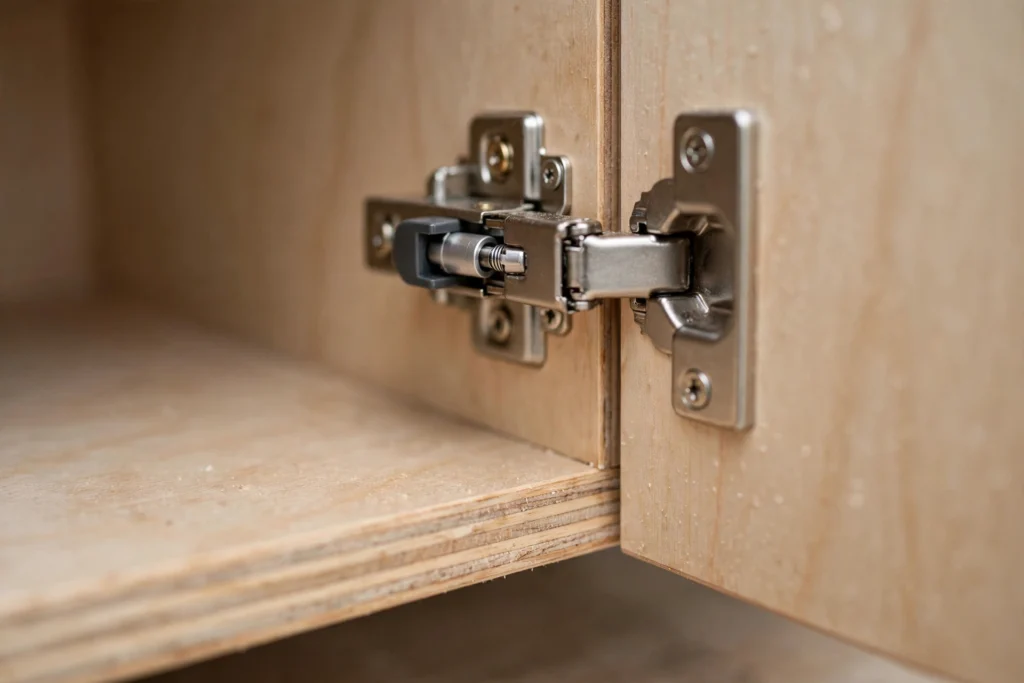
Hinges and Hardware: Don’t Reuse the Bad Stuff
New doors deserve decent hinges. If your old hinges are more than 15 years old, replace them:
- Soft-close concealed hinges: the standard now. About $3–$8 per hinge, and they stop doors from slamming. Non-negotiable in my book — it’s the cheapest luxury in the kitchen.
- Check the overlay spec on the hinge matches your doors (full overlay, half overlay, or inset hinges are different parts).
- Knobs and pulls: new doors are the perfect excuse for new hardware. Budget $2–$10 per piece. Drill the hardware holes before hanging the doors — it’s much easier on a flat workbench than on a hung door.
Finishing Unfinished Doors
Buying unfinished and finishing yourself saves real money — but the finish is everything. A bad paint job ruins good doors.
- Painting: use a dedicated cabinet paint (alkyd or urethane-modified acrylic), not wall paint. Sand with 220-grit between coats, minimum two coats, and let them cure fully — cabinet paint feels dry in hours but needs up to 30 days to fully harden. Spraying beats brushing for a smooth finish; a $100 HVLP sprayer pays for itself on one kitchen.
- Staining: wood conditioner first (prevents blotchiness, especially on maple and pine), then stain, then at least two coats of polyurethane. Oil-based poly is tougher; water-based dries faster and doesn’t yellow.
- Drying space: you need somewhere dust-free to lay out 20+ doors. Sawhorses in a garage work. Don’t rush this — dust in wet paint is forever.
What New Cabinet Doors Cost: The Full Picture
| Option | Typical cost | Best for |
|---|---|---|
| Unfinished MDF Shaker door | $25–$50 per door | DIY painters on a budget |
| Finished stock door | $40–$80 per door | Standard sizes, quick turnaround |
| Custom/wood door | $80–$150+ per door | Odd sizes, premium species |
| New soft-close hinges | $3–$8 per hinge | Every replacement project |
| New knobs/pulls | $2–$10 each | The finishing touch |
| Full DIY door swap (avg kitchen) | $1,500–$4,000 | Solid boxes, same layout |
| Professional refacing | $4,000–$10,000 | Dated frames, solid boxes |
Kitchen Cabinet Doors: FAQs
Can I just replace my kitchen cabinet doors and keep the boxes?
Yes — if the boxes are structurally solid, level, and you like the layout. This is the most cost-effective kitchen update there is. If boxes are water-damaged, warped, or the layout drives you crazy, replacement won’t fix the underlying problems.
How much does it cost to replace kitchen cabinet doors?
For a typical kitchen (about 20 doors and 10 drawer fronts), expect $1,500–$4,000 in materials doing it yourself, or $4,000–$10,000 for professional refacing (doors plus new veneer on the frames).
Where can I buy kitchen cabinet doors only?
Online made-to-order door manufacturers offer the best selection and prices. Local cabinet shops are better for odd sizes and finish matching. Big-box stores work for standard sizes you can see in person.
Should I replace or reface my cabinets?
Replace doors only when the visible frame already matches or you don’t mind it. Reface (doors + new veneer on frames) when the frame wood is dated or damaged but boxes are solid. Full replacement when the layout or structure is the problem.
What is the most popular kitchen cabinet door style?
Shaker, by a wide margin. It’s been the top seller for over a decade because it works in nearly every kitchen style and doesn’t look dated.
Are soft-close hinges worth it?
Completely. At $3–$8 per hinge, they’re the cheapest meaningful upgrade in the kitchen. No more slamming doors, and they make even budget cabinets feel premium.
Can I put new doors on 30-year-old cabinets?
If the boxes are solid and square, yes. Check for water damage (especially under the sink), make sure the boxes are level, and confirm standard hinge boring will work. Particleboard boxes that have swollen from moisture are not worth saving.
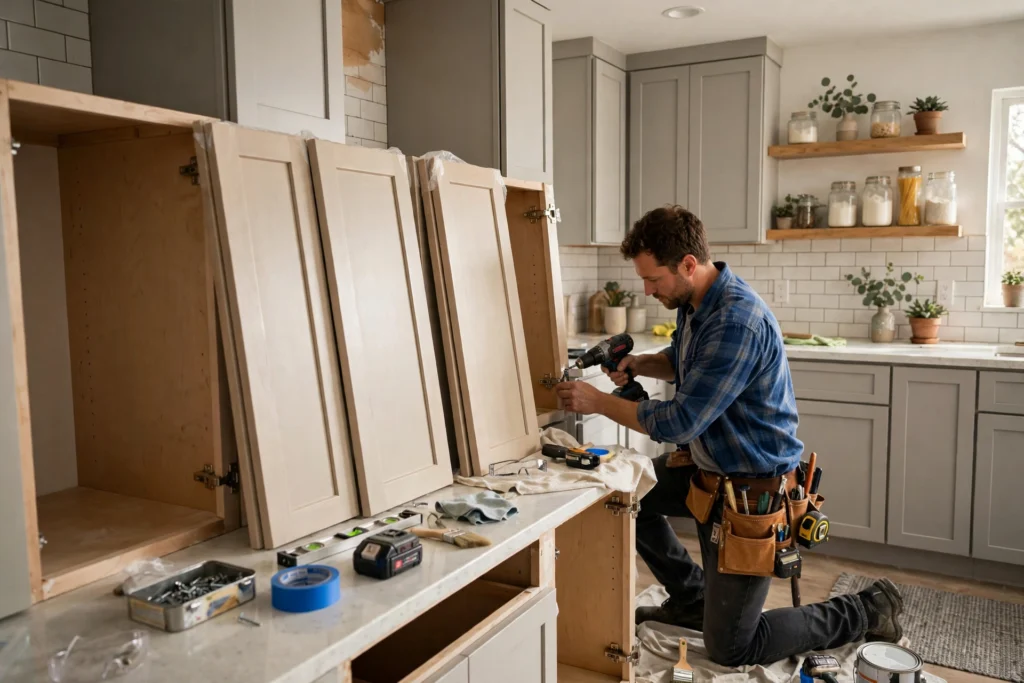
Cabinet doors are the rare home improvement where the cheap option is also the smart option — as long as the bones underneath are good. Measure carefully, don’t cheap out on hinges, and take the finishing seriously. Do that, and nobody will ever guess the boxes are older than the doors.