
RTA — ready-to-assemble — kitchen cabinets are the open secret of budget kitchen remodels. The cabinets arrive flat-packed in boxes, you (or someone you hire) assemble them with cam locks and screws, and you end up with cabinets that cost 30–40% less than the same cabinets pre-assembled. Thousands of kitchens a year are built this way, and most visitors would never guess.
But “ready to assemble” covers everything from genuinely good plywood cabinets to flimsy particleboard junk that swells the first time the dishwasher steams. This guide covers what RTA really means, how the quality breaks down, what you’ll actually pay versus pre-assembled, and how to assemble them without losing your mind.
What “Ready to Assemble” Actually Means
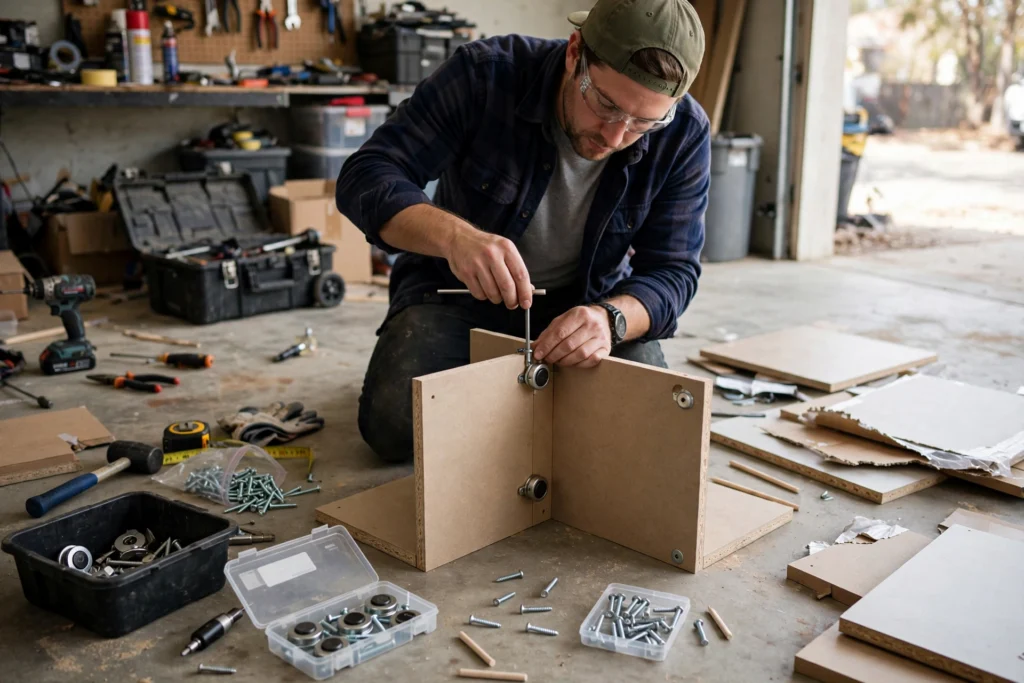
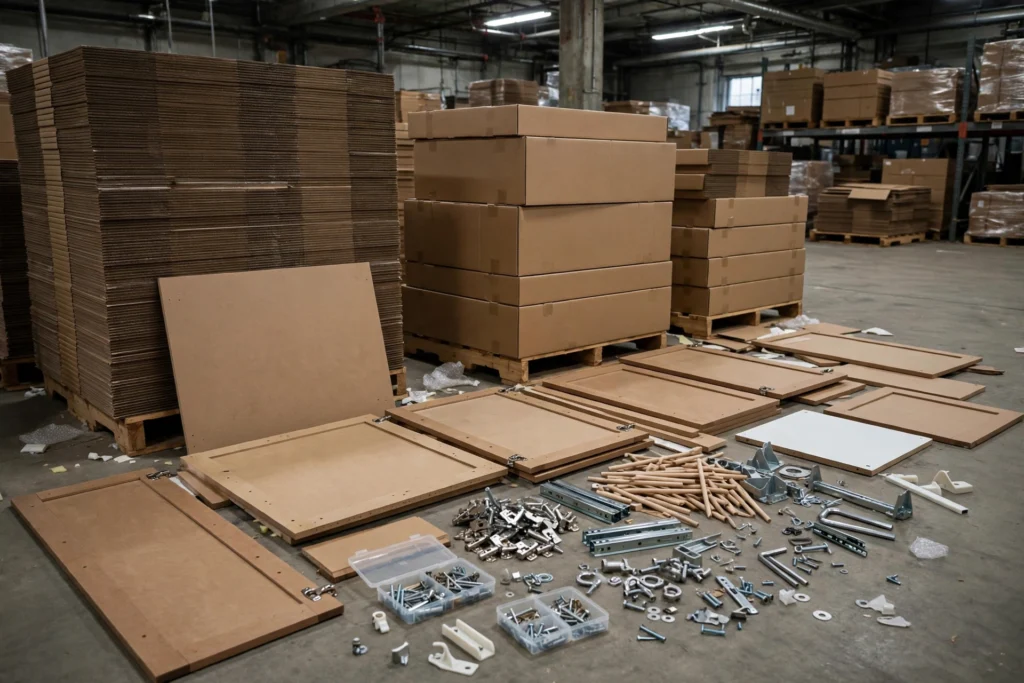
RTA cabinets ship flat — panels, shelves, doors, and hardware packed flat in cardboard boxes, usually from a warehouse to your door via freight. Assembly happens on-site: you connect the panels with the included fasteners (typically cam locks, wood dowels, screws, and glue), attach the doors and drawer fronts, and install them like any other cabinet.
The concept isn’t new — it’s the same flat-pack logic as IKEA, scaled up to full kitchen cabinetry. What changed is the quality: the best RTA lines now use 3/4″ plywood boxes, solid wood doors, dovetailed drawer boxes, and soft-close hardware as standard. The gap between good RTA and mid-range pre-assembled cabinets has basically closed; the main thing you’re giving up is someone else doing the assembly.
Assembly time is real, though. A single base cabinet takes 20–45 minutes for a first-timer, 10–15 once you’ve done a few. A full 10×10 kitchen — say 18 boxes — is a solid weekend of assembly before installation even starts. Budget for it honestly.
RTA vs. Pre-Assembled: The Real Comparison
The same cabinet line often sells in both RTA and pre-assembled versions, which makes the comparison clean:
| RTA | Pre-assembled | |
|---|---|---|
| Cost (10×10 kitchen) | $2,500–7,000 | $4,000–11,000 |
| Shipping | Flat-pack, cheaper freight | Bulky, higher freight, more damage risk |
| Assembly time | 15–25 hours DIY | Zero |
| Quality of the cabinet itself | Identical (same line) | Identical (same line) |
| Damage in transit | Rare (flat panels) | More common (corners, doors) |
| Storage before install | Stacks flat in a garage | Needs a whole room |
The price gap — typically 30–40% — is almost entirely the labor of assembly and the cost of shipping air (assembled cabinets are mostly empty space). The cabinets themselves are the same parts from the same factory.
My honest take: if you’re even slightly handy and the kitchen isn’t enormous, RTA is the best value in cabinetry right now. The assembly is more tedious than difficult — it’s adult LEGO with an Allen wrench. If you hate assembling furniture, pay the premium for pre-assembled or hire a handyman to assemble RTA boxes ($50–100 per cabinet is the going rate, which still keeps you under pre-assembled pricing).
RTA Cabinet Quality: What Separates Good From Junk
This is the section that matters most, because RTA quality varies more than any other cabinet category. Two cabinets can both be called “RTA” while one lasts 25 years and the other swells up in three. Here’s what to check:
Box material — the #1 quality signal. Good RTA: 3/4″ plywood boxes (sometimes listed as “all-plywood construction”). Acceptable: 1/2″ plywood or furniture-board with plywood sides. Walk away from: particleboard boxes, especially at the sink base. Ask specifically; some listings bury this in the specs.
Drawer boxes. Dovetailed solid wood drawer boxes are the mark of a quality line. Glued-and-stapled particleboard drawers are the mark of a cheap one. This is a part you’ll touch every day — it matters more than people think.
Hardware. Soft-close hinges and full-extension soft-close drawer slides should be standard, not upgrades. Blum, DTC, and Grass are the names to look for. If a line charges extra for soft-close in 2026, it’s behind the curve.
Finish. Factory finishes on good RTA lines are catalyzed conversion varnish — harder and more even than anything you’ll do at home. Check that doors and face frames match (order samples — most companies ship door samples for $10–30, credited toward your order).
Certifications. KCMA (Kitchen Cabinet Manufacturers Association) certification means the line passed standardized durability testing. It’s not a guarantee of perfection, but it’s a meaningful floor — uncertified bargain lines are where the horror stories come from.
Red flags: no physical samples available, specs that don’t state box material, “some assembly required” lines where doors come unfinished with no finish option, prices that seem impossibly low ($1,500 for a full kitchen is not a deal, it’s a warning), and companies with no reachable customer service before the sale — because you’ll need them after it.
What RTA Kitchen Cabinets Cost
For a standard 10×10 kitchen (roughly 20 linear feet):
- Budget RTA: $2,500–4,000. Plywood or furniture-board boxes, basic door styles, limited colors. Perfectly serviceable; this is the “looks great in photos, works fine for a decade” tier.
- Mid-range RTA: $4,000–7,000. All-plywood construction, dovetailed drawers, soft-close everything, wider style and color selection, better finish quality. This is the sweet spot — comparable to $8,000–12,000 pre-assembled or semi-custom.
- Premium RTA: $7,000–12,000. Inset doors, exotic finishes, custom modifications. At this price you’re approaching semi-custom territory; make sure the RTA format is still saving you real money.
Add assembly ($0 DIY, or $1,000–2,000 hired) and installation ($2,000–5,000 pro, or DIY with our installation guide). For the full budget picture including counters and the rest, see our kitchen cabinet costs breakdown.
One cost people miss: freight shipping. RTA ships by freight truck, not UPS. Budget $200–500 for freight on a full kitchen, and make sure someone’s home to receive it — freight companies don’t leave $5,000 of cabinets on the porch.
Buying RTA Kitchen Cabinets Online
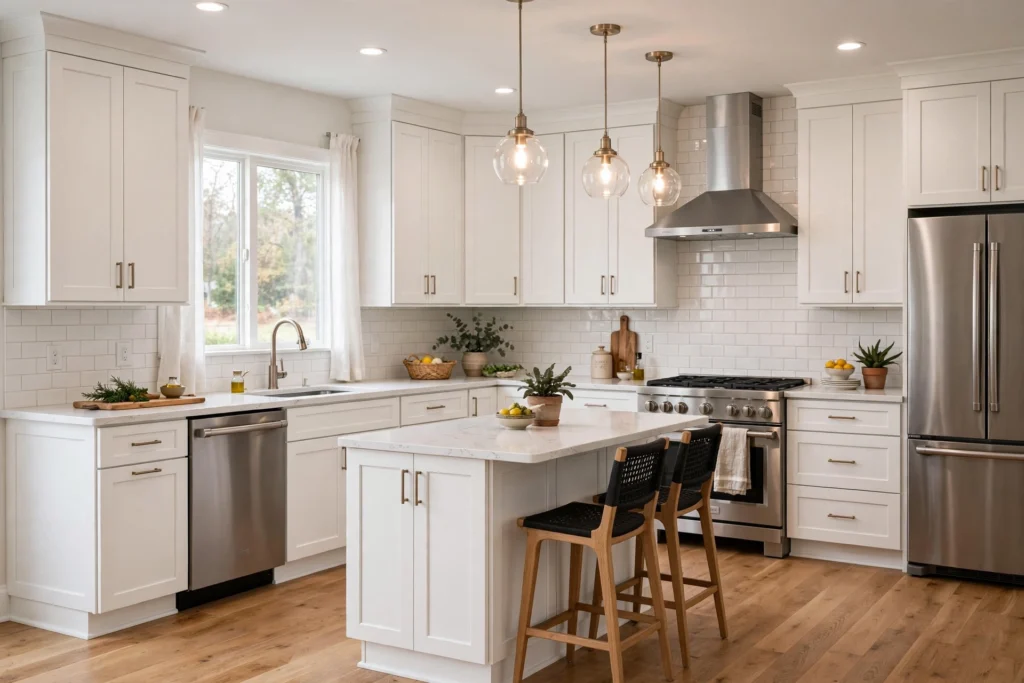
Most RTA buying happens online now — the big online RTA retailers (there are a dozen major ones) beat local pricing because they ship factory-direct from central warehouses. The process:
- Get your kitchen measured and designed. Most RTA companies offer free design services — send them your measurements and they’ll produce a cabinet layout with a quote. Use this even if you’re confident; a second set of eyes catches filler and clearance mistakes.
- Order door samples. $10–30 each, usually credited back. Do this. Colors on screens lie, and finish quality is something you need to touch.
- Review the design carefully. Check every cabinet size against your standard cabinet dimensions knowledge. Verify fillers at walls and corners. Confirm the sink base fits your sink. This is your last cheap chance to catch errors.
- Order 4–6 weeks before you need them. RTA lead times are usually 1–3 weeks, but freight scheduling and the occasional backordered door style can stretch it. Don’t demo your kitchen until the cabinets are in your garage.
- Inspect on delivery. Open every box and check for damage before the freight driver leaves. Damaged parts get replaced free, but only if you report them promptly — photograph everything.
If you’re bargain hunting more broadly, our cheap kitchen cabinets guide covers the other budget paths (stock, clearance, used) and how they stack up against RTA.
Assembly Tips: Getting Through the Flat-Pack Marathon
Set up an assembly line. Clear the garage or a large room. Unbox everything, group parts by cabinet, and keep the hardware bags with their cabinets — mixing up hinge packs across 18 cabinets is a special kind of misery.
Read one manual fully before starting. Every line’s cam-lock system is slightly different. Assemble the first cabinet slowly, following the instructions exactly. Cabinets 2 through 18 go fast once the pattern clicks.
Glue everything. Most RTA instructions list wood glue as optional. It’s not optional — glued joints are dramatically stronger and they eliminate the micro-wobble that makes cheap RTA feel cheap. A $5 bottle of Titebond II across the whole kitchen is the best money you’ll spend.
Don’t overtighten cam locks. Snug is enough. Cranking them strips the particleboard or cracks the panel, and then the joint is weaker than if you’d left it slightly loose. If a cam lock spins freely, the panel is stripped — a dab of glue and a toothpick in the hole fixes it.
Assemble square, verify square. Measure diagonals on every box. A box that’s out of square at assembly becomes a door that won’t close at installation. This takes ten seconds per cabinet and saves hours later.
Install the doors and drawers after the boxes are installed, not during assembly. Doors get damaged during handling; hang them last. Same for drawer fronts — install the drawer boxes during assembly, fronts after installation.
Keep a “parts hospital” box. Every RTA order has a few extra screws, shelf pins, and cam locks. Don’t throw them away — when you discover a missing hinge plate at 9 PM on a Sunday, you’ll be glad.
RTA Pros and Cons: The Honest Summary
Pros: 30–40% cheaper than identical pre-assembled cabinets; flat-pack shipping means less transit damage and easier handling; wide style selection online; quality lines genuinely rival semi-custom; you control the assembly quality (and with glue, it’s often better than factory).
Cons: 15–25 hours of assembly labor; you need space to assemble and store; resolving damaged/missing parts takes days by freight (order spares of nothing, but inspect fast); no local showroom to see full kitchens (samples only); installation is still on you.
Frequently Asked Questions
Are RTA kitchen cabinets good quality? The good ones are — all-plywood boxes, dovetailed drawers, soft-close hardware, and KCMA certification put top RTA lines on par with mid-range pre-assembled cabinets. The bad ones are genuinely bad. Quality varies more in RTA than any other category, so check box material, drawer construction, and hardware before buying, and always order samples.
How much can I save with RTA cabinets vs. pre-assembled? Typically 30–40% on the cabinets themselves. On a 10×10 kitchen, that’s $1,500–4,000 in savings — minus the value of your assembly time (15–25 hours). Even hiring assembly help at $50–100 per cabinet usually keeps RTA cheaper than pre-assembled.
How long does it take to assemble RTA cabinets? 20–45 minutes per cabinet for a first-timer, 10–15 minutes once you’re in the groove. A full 10×10 kitchen (about 18 boxes) is 15–25 hours total — a long weekend. Installation is separate and takes another 1–3 days.
Do RTA cabinets come with a warranty? Reputable RTA lines carry 5-year to limited-lifetime warranties on manufacturing defects — similar to pre-assembled cabinets in the same price tier. Read the fine print: warranties cover defects, not damage from improper assembly or installation, which is why following the instructions (and using glue) matters.
Can I install RTA cabinets myself? Yes — once assembled, RTA cabinets install exactly like any other cabinets: level line, screw boxes together, screw into studs. Our step-by-step installation guide walks through the whole process. If you assembled them, you can install them.
Where’s the best place to buy RTA kitchen cabinets online? The major online RTA retailers all work on the same model: free design service, door samples, freight shipping. Compare at least three on identical designs — pricing for the same quality tier varies 15–25% between retailers. Prioritize companies with real customer service (call them before ordering; if you can’t reach a human, don’t send them $5,000) and clear warranty terms.
Pingback: Cheap Kitchen Cabinets: Complete Guide