
Custom kitchen cabinets are the top of the cabinet food chain — built to your exact specifications, in any size, any wood, any finish, by a cabinetmaker or custom shop. They’re also the most misunderstood purchase in kitchen remodeling, because “custom” gets thrown around by everyone from genuine one-man shops to big-box stores selling semi-custom lines with a markup.
This guide sorts out what custom really means, what it actually gets you over semi-custom and stock, the real costs and lead times, and — most importantly — when custom is worth the money and when it’s an expensive way to buy things you don’t need.
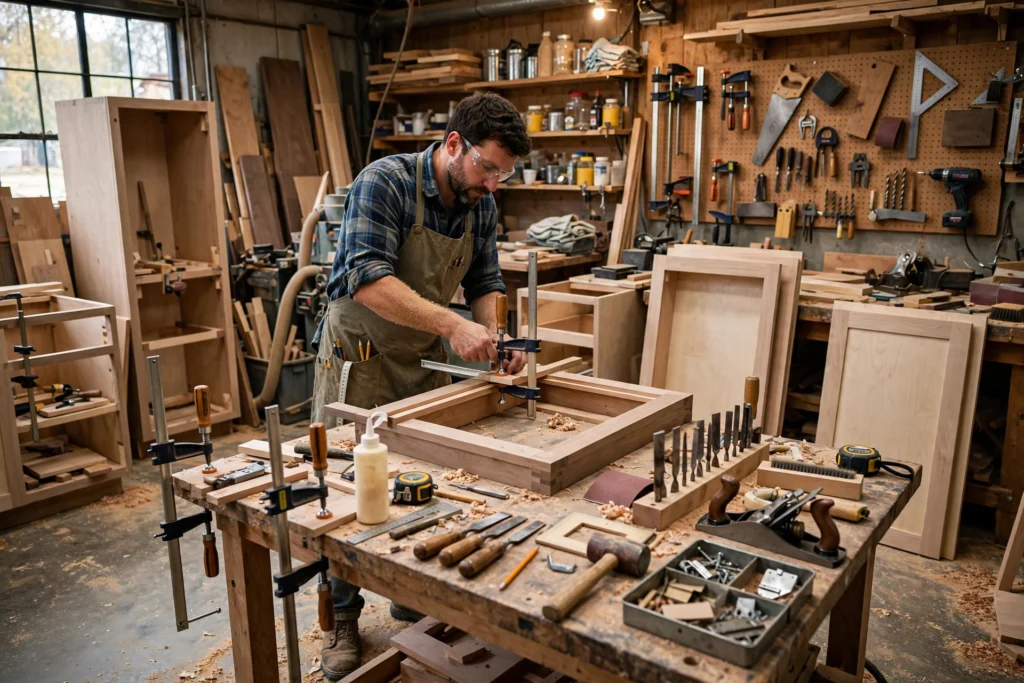
What “Custom” Really Means (And What It Doesn’t)
True custom cabinets are built from scratch for your kitchen. No standard sizes, no catalog — the cabinetmaker designs each box around your space, your appliances, and your wish list. Want a 27-3/8″ wide cabinet to fit exactly between the window and the wall? A spice pull-out sized for your specific bottles? A range hood surround that matches the mantel in your living room? That’s custom.
Here’s where it gets murky: the industry uses “custom” loosely. What many retailers call “custom” is actually semi-custom — a stock cabinet line with modification options (depth changes in 1″ increments, custom heights, extra finishes). Semi-custom is a real step up from stock, but it’s not the same as a cabinetmaker building to your sixteenth-of-an-inch measurements.
The three tiers, plainly:
- Stock: Fixed sizes (3″ width increments), fixed styles, fixed finishes. Take it or leave it. Cheapest, fastest.
- Semi-custom: Stock platform with modifications — altered depths, heights, finishes, organizers, decorative options. 3–6 week lead times. The middle ground most kitchen remodels actually need.
- Custom: Built from scratch to your specs. Any size, any wood, any finish, any detail. 8–16 week lead times. Priced accordingly.
If a salesperson says “custom” but hands you a catalog with option codes, you’re looking at semi-custom. There’s nothing wrong with semi-custom — it’s the right answer for most kitchens — but you should know what you’re paying for.
What Custom Cabinets Actually Get You
Strip away the marketing and custom buys you four things:
1. Exact fit. Stock and semi-custom work in 3″ increments with fillers covering the gaps. Custom fills the wall precisely — no filler strips, no wasted inches. In a small or awkward kitchen, those reclaimed inches matter: a custom shop can squeeze a 6″ pull-out where stock leaves a dead filler panel.
2. Any material and finish. Want rift-sawn white oak with a cerused finish? Walnut interiors? A 12-step hand-rubbed glaze? Custom shops do finishes that factories can’t — or won’t — at any price. If you can describe it, a good finisher can match it.
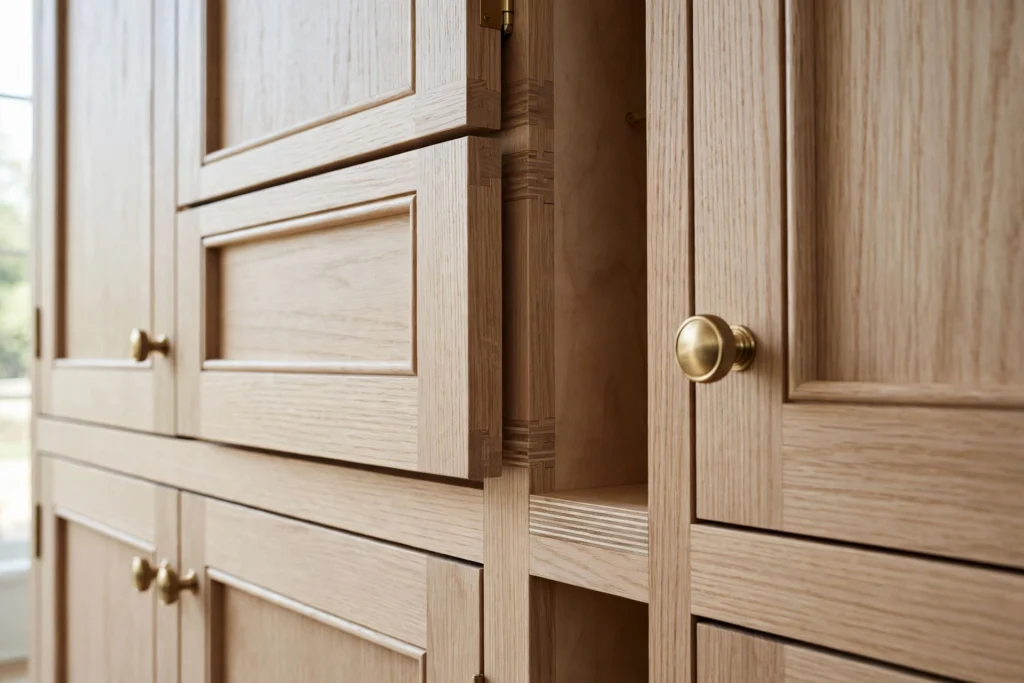
3. Structural and detail upgrades. Thicker boxes (3/4″ throughout, not just the spec sheet’s “select” panels), real dovetailed drawers as standard, inset doors with beaded face frames, furniture-style details like turned legs and arched valances, integrated lighting channels, appliance panels that make the fridge disappear. The details that make a kitchen look like furniture instead of cabinetry.
4. Problem-solving. Angled walls, sloped ceilings, a 200-year-old house where nothing is plumb — custom is the only answer when the room itself is non-standard. A good cabinetmaker has seen your weird corner before.
Custom vs. Semi-Custom: An Honest Comparison
For most buyers, the real decision isn’t custom vs. stock — it’s custom vs. semi-custom, because semi-custom has gotten very good.
| Semi-custom | True custom | |
|---|---|---|
| Sizing | 3″ increments + modifications | Any size, to the 1/16″ |
| Wood species | 4–8 options | Anything available |
| Finishes | 20–40 catalog finishes | Unlimited, including matching existing |
| Door styles | 15–30 catalog styles | Any profile, including reproductions |
| Lead time | 3–6 weeks | 8–16 weeks |
| Cost (10×10 kitchen) | $8,000–20,000 | $15,000–40,000+ |
| Designer help | Usually included | Sometimes; often you hire separately |
My honest take: semi-custom covers 85% of kitchens beautifully. The modifications most people actually want — deeper drawers, a taller wall cabinet, a specific paint color — are all available semi-custom. True custom earns its premium in three situations: non-standard spaces, furniture-grade detail work, and finishes you can’t get from a catalog.
What Custom Kitchen Cabinets Cost
Custom pricing is the least standardized thing in cabinetry — it varies by region, shop reputation, materials, and finish complexity. But here are real ranges for a standard 10×10 kitchen (about 20 linear feet):
- Small local shop, painted maple, straightforward design: $15,000–22,000
- Established custom shop, premium details (inset doors, dovetailed drawers, upgraded finish): $22,000–35,000
- High-end shop, exotic woods, complex finishes, furniture details: $35,000–60,000+
Per linear foot, custom typically runs $500–1,500+, versus $300–650 for semi-custom and $100–300 for stock. Installation is usually separate: $3,000–8,000 for a pro install of custom work (and yes, you want a pro — custom deserves better than a rushed install).
What drives the price up: inset door construction (each door is fitted individually — labor-intensive), exotic or wide-plank woods, multi-step or hand-applied finishes, unusual sizes that waste material, integrated lighting, and anything curved. What keeps it reasonable: painted finishes (cheaper than stain-grade exotic woods), overlay doors instead of inset, standard-ish sizes even within a custom build, and a simple door style.
For context on where custom sits in the full pricing landscape, our kitchen cabinet costs guide breaks down every tier.
Lead Times: The Part Nobody Warns You About
Custom cabinets take time — 8 to 16 weeks from approved design to delivery is normal, and 20+ weeks isn’t unusual for in-demand shops. Here’s the typical timeline:
- Design and quoting: 2–4 weeks (measurements, revisions, final approval)
- Shop scheduling: 2–6 weeks (good shops have a backlog — that’s actually a good sign)
- Build: 3–5 weeks
- Finish: 1–3 weeks (finish work can’t be rushed; curing takes what it takes)
- Delivery and installation: 1–2 weeks
Plan your remodel around the cabinets, not the other way around. Don’t demo the kitchen until the cabinets have a confirmed delivery date. The classic custom-cabinet disaster is a gutted kitchen and a shop that’s “two more weeks out” for the third time. Get the delivery commitment in writing, with a penalty or at least a clear communication plan for delays.
Also worth knowing: custom shops are small businesses. If the shop owner gets sick, takes a big commercial job, or has a finishing problem, your timeline moves. This isn’t a reason to avoid custom — it’s a reason to build buffer into your schedule and keep the relationship friendly.
How to Find a Good Cabinetmaker
This is the highest-stakes part of buying custom, because the quality spread between shops is enormous. A great cabinetmaker is worth every penny; a bad one is the most expensive mistake in your remodel.
Where to look:
- Referrals from kitchen designers and contractors. This is the #1 source. Designers stake their reputation on their cabinetmakers — ask who they use for their own projects, not just client work.
- Local woodworking guilds and associations. Many regions have professional woodworking groups; members tend to be serious craftspeople.
- Cabinet shops with showrooms. A showroom with finished displays tells you more than any portfolio photo. Open the drawers. Look at the inside corners. Check how doors close.
- Word of mouth. Ask at lumberyards that sell hardwoods — they know who buys the good stuff and who doesn’t.
Vetting questions that matter:
- Can I see a kitchen you finished 3+ years ago? (Finish durability is the real test)
- Who does your finishing — in-house or subcontracted?
- What’s your current backlog, and what happens if you run over?
- Do you build the boxes yourself or buy them? (Some “custom” shops buy stock boxes and only make doors — that’s semi-custom with extra steps)
- What’s your payment schedule? (Never pay more than 50% upfront. Standard is 40–50% deposit, balance on delivery/installation)
- What does your warranty cover, and for how long?
Red flags: no physical shop you can visit, pressure to sign immediately (“this price is only good today”), full payment upfront, no references from the last two years, and quotes dramatically lower than everyone else — in custom work, the cheapest bid is usually missing something expensive.
Affordable Custom Kitchen Cabinets: Is “Budget Custom” Real?
You’ll see “affordable custom kitchen cabinets” and “custom kitchen cabinets online” advertised everywhere. Here’s what’s actually behind those phrases:
Most online “custom” cabinet companies are selling made-to-order semi-custom — you pick from their options, they build to your sizes, and it ships to you. Quality ranges from decent to quite good, prices run 20–40% below local custom shops, and you lose the in-person design relationship and the truly unlimited options. For straightforward kitchens, this middle path is genuinely good value.
True budget custom — a local one- or two-person shop building from scratch at near-stock prices — exists but is rare, and usually means simpler construction, painted finishes, and longer waits (you’re filling gaps in their schedule). If you find one with good references, it’s the best deal in cabinetry. Just verify the references thoroughly.
When Custom Is Worth It (And When It Isn’t)
Worth it when: the kitchen has non-standard dimensions or angles; you want inset doors, beaded frames, or furniture-grade details; you’re matching existing woodwork or a specific finish; you’re staying in the house long-term and the kitchen is the centerpiece; the budget genuinely supports it without strain.
Not worth it when: the kitchen is a standard rectangle that stock sizes fill fine; you’re selling within 5 years (you won’t recoup the premium — buyers can’t tell custom from good semi-custom); the budget is tight enough that custom means cutting corners on counters, appliances, or flooring; or you just like the idea of custom but would be equally happy with a good semi-custom line. Be honest about which one it is.
Our buying guide walks through the full stock-to-custom decision if you’re still weighing the tiers — and if budget is the main driver, compare against RTA cabinets before you rule anything out. Good RTA at $5,000 versus custom at $25,000 is a $20,000 question that deserves a clear-eyed answer.
Frequently Asked Questions
How much do custom kitchen cabinets cost? For a standard 10×10 kitchen, expect $15,000–40,000+ depending on the shop, materials, and details — roughly $500–1,500+ per linear foot. Painted maple with overlay doors from a small local shop starts around $15,000–22,000; inset doors, exotic woods, and complex finishes push well past $35,000.
How long does it take to get custom cabinets? 8–16 weeks from approved design to delivery is typical; 20+ weeks happens with in-demand shops. Design and quoting add 2–4 weeks before that. Don’t demolish your kitchen until you have a confirmed delivery date in writing.
Are custom cabinets worth the money? They’re worth it for non-standard spaces, furniture-grade details (inset doors, hand-applied finishes), and long-term homes where the kitchen is a priority. For standard kitchens, good semi-custom delivers 90% of the result at half the price — and buyers at resale can’t tell the difference.
What’s the difference between custom and semi-custom cabinets? Semi-custom starts from a stock platform with modification options (sizes in 3″ increments, catalog finishes, option codes). True custom is built from scratch to your exact measurements with unlimited material and finish choices. If you’re picking from a catalog, it’s semi-custom regardless of what the brochure says.
Can I get custom cabinets online? Yes — several online companies offer made-to-order cabinets built to your sizes with broad option lists, typically 20–40% cheaper than local custom shops. It’s a middle path: more flexible than stock, less unlimited than a local cabinetmaker, and you handle measuring and design remotely. Verify quality through samples and reviews before committing.
Do custom cabinets increase home value? They help, but with diminishing returns. A beautiful kitchen helps sell any house, but appraisers and buyers don’t pay dollar-for-dollar for the custom premium — a $30,000 custom kitchen doesn’t appraise $20,000 higher than a $10,000 semi-custom one. Buy custom because you want to live with it, not as an investment strategy.