
Ask ten people what kitchen cabinets cost and you’ll get ten different numbers, because “kitchen cabinets” can mean a $2,000 RTA flat-pack or a $50,000 bespoke build. Both are real answers. Neither helps you budget.
So let’s do this properly: real price ranges by cabinet type, what actually drives the price up or down, the hidden costs nobody mentions until the invoice arrives, and how to build a cabinet budget that survives contact with reality.
The Short Answer: Kitchen Cabinet Price Ranges
For a typical 10×10 kitchen (the industry’s standard measuring stick — about 20 linear feet of cabinets):
| Cabinet type | Typical total | Per linear foot |
|---|---|---|
| RTA (ready-to-assemble) | $1,500 – $5,000 | $75 – $250 |
| Stock | $3,000 – $8,000 | $100 – $350 |
| Semi-custom | $8,000 – $20,000 | $200 – $650 |
| Custom | $20,000 – $40,000+ | $500 – $1,200+ |
These are cabinet-only numbers in most cases. Installation typically adds $1,500 to $8,000 depending on complexity and your market — we’ll get to that.
My honest take on these ranges: the low end of each tier is real but requires discipline. The moment you start adding pull-outs, glass doors, and specialty finishes, you drift toward the top of the range fast. Budget for the middle, hope for the low end.
What Drives Kitchen Cabinet Prices Up (or Down)
Cabinets aren’t priced by magic. Seven factors do almost all the work:
1. Construction type. This is the big one. RTA < stock < semi-custom < custom, in that order, every time. Jumping one tier roughly doubles the price. See our kitchen cabinets buying guide for the full tier breakdown.
2. Box material. Plywood boxes cost 15–30% more than particleboard. Worth it for the sink base and any cabinet near water; elsewhere it’s a judgment call.
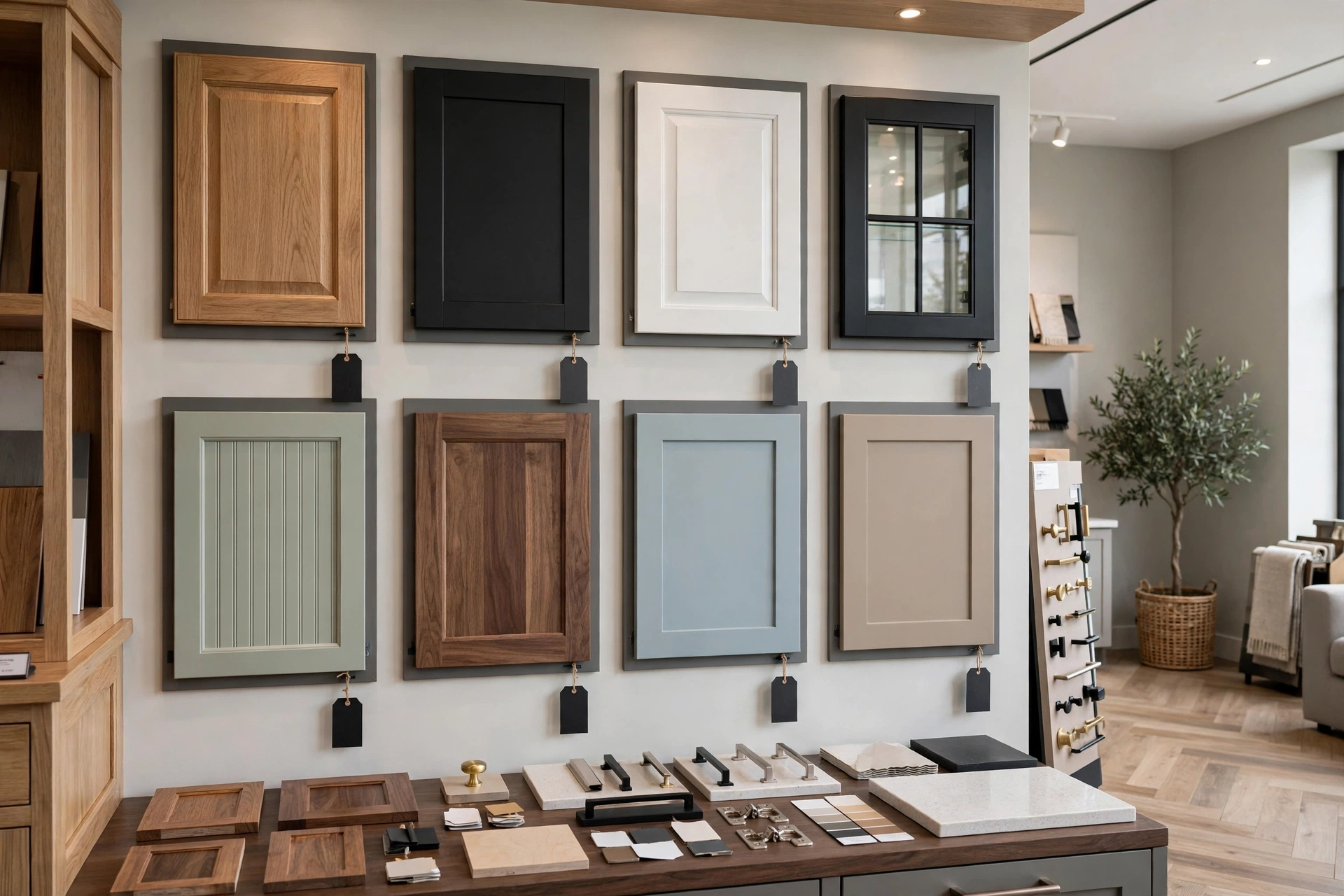
3. Door style and finish. Flat shaker doors in white paint: baseline. Inset doors: +30–50%. Exotic wood species or multi-step hand-applied finishes: +50% and up. Glass-front doors cost more than solid ones (the glass, the finished interior, the extra labor). Every decorative flourish has a price tag.
4. Wood species. For stained cabinets, the pecking order runs roughly: oak and maple (most affordable), hickory and alder (mid), cherry and walnut (premium). Painted cabinets sidestep this entirely — paint-grade maple or MDF costs the same regardless of the “wood” underneath.
5. Hardware and accessories. Soft-close hinges and drawer glides: a few hundred dollars for the whole kitchen and worth every penny. Pull-out trash bins, lazy Susans, spice pull-outs, tray dividers, mixer lifts: $75–$400 each, and they add up terrifyingly fast. A fully accessorized kitchen can add $2,000–$4,000 in hardware alone.
6. Kitchen size and layout complexity. More linear feet = more money, obviously. But complexity matters too: corners need lazy Susans or blind-corner pull-outs ($200–$600 each), tall pantry cabinets cost more per unit than standard bases, and islands need finished panels on all sides.
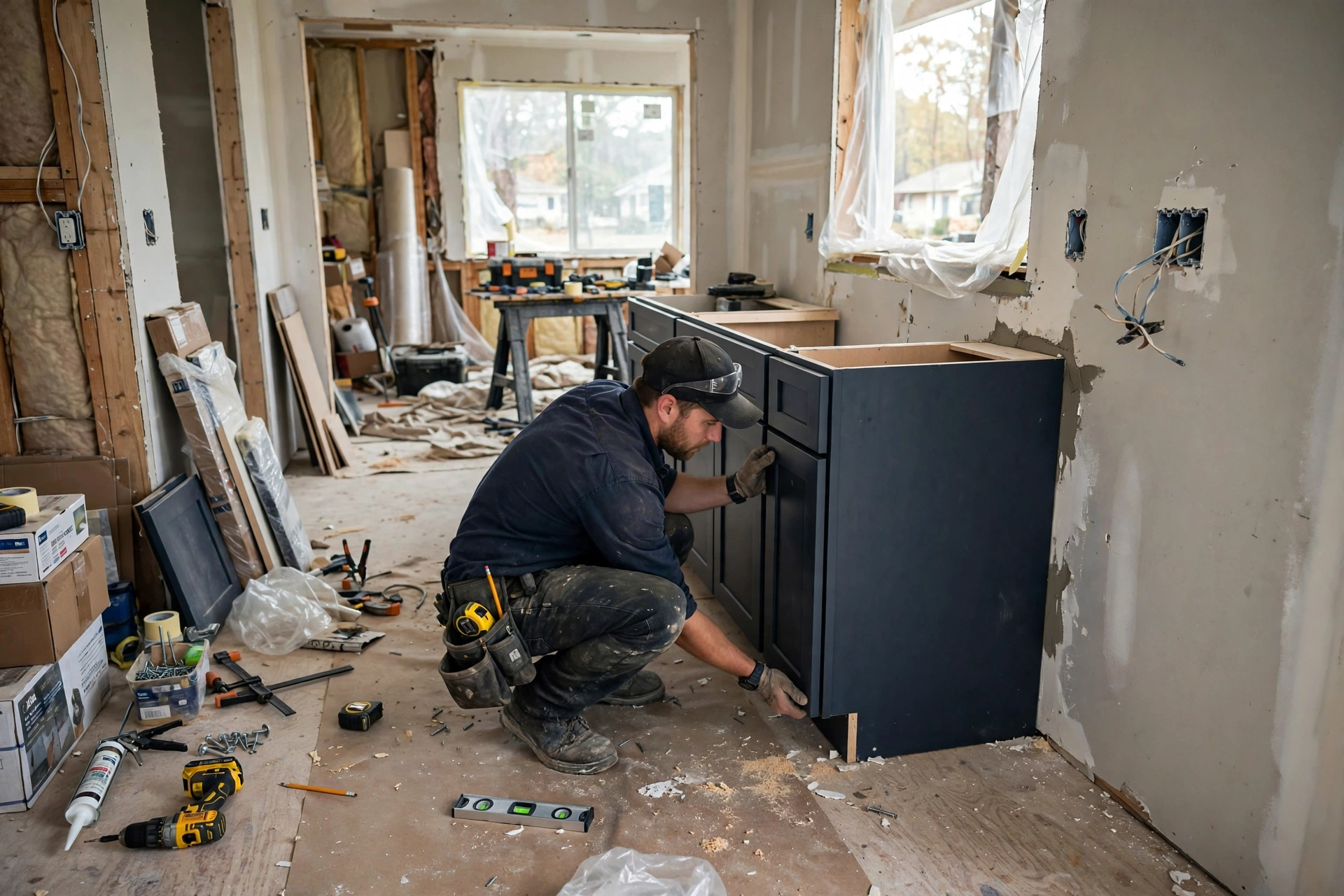
7. Installation. DIY: free (plus your weekends). Professional install: $50–$150 per cabinet, or $1,500–$8,000 for the kitchen. Custom and complex layouts cost more to install; RTA you assemble yourself saves the assembly labor but you still pay for the actual installation unless you DIY that too.
Installation Costs: The Forgotten Line Item
People budget for cabinets and forget that someone has to hang them. Here’s what installation actually costs:
- DIY: $0 in labor, but budget $200–$400 for tools and supplies you don’t own (shims, screws, a good level, caulk). And your time — a first-timer should budget a full weekend for a small kitchen, longer for a big one.
- Handyman install: $1,500–$3,500 for a straightforward stock or RTA kitchen. Fine for simple layouts.
- Professional cabinet installer: $3,000–$8,000. Worth it for semi-custom and custom, anything with tricky corners, or walls that aren’t plumb (most walls aren’t).
- Full-service (dealer installation): often bundled into the quote at $100–$200 per linear foot. Convenient, and the dealer handles warranty issues, but you’re paying retail for the labor.
One rule: never let installation be an afterthought in the quote. A $6,000 cabinet quote with a $4,000 install is a $10,000 project, and comparing it against an $8,000 all-in quote requires doing the math.
The Hidden Costs Nobody Warns You About
The cabinet quote is never the final number. Budget 15–20% extra for these:
- Delivery: $100–$500, more for RTA freight shipments. Some dealers include it; many don’t.
- Finished end panels: $50–$150 each. Any cabinet end that’s visible needs a finished panel, and quotes often list the boxes without them.
- Toe kicks, fillers, and scribe molding: $200–$600 total. The unglamorous trim that makes cabinets look built-in instead of plopped down.
- Crown molding: $5–$15 per linear foot installed. Skipping it saves money; adding it makes stock cabinets look twice as expensive.
- Countertop templating delays: not a cabinet cost, but cabinets must be installed before countertops get measured, which adds 1–3 weeks to your timeline. Plan for it.
- Plumbing and electrical: moving a sink or adding under-cabinet lighting isn’t in the cabinet quote. Under-cabinet LED strips run $200–$600 installed and are worth it.
- Old cabinet removal and disposal: $500–$1,500 if you’re not doing demo yourself.
How to Budget for Kitchen Cabinets (Without Regret)
Step 1: Start from the total remodel budget. Cabinets should be 30–40% of a full kitchen remodel. $30,000 remodel → $9,000–$12,000 for cabinets. If cabinets alone would eat 60% of your budget, you’re shopping a tier too high.
Step 2: Pick your tier and sanity-check it. Your budget points at a tier (see the table up top). If you’re between tiers, the lower tier with smart upgrades usually beats the higher tier stripped bare. A well-accessorized stock kitchen outperforms a bare-bones semi-custom one in daily use.
Step 3: Price the accessories separately. Get the base cabinet quote, then add accessories à la carte. This is where budgets die — it’s easy to say yes to a $300 pull-out six times. Decide your must-haves (trash pull-out, drawer dividers, a lazy Susan for the blind corner) and treat the rest as nice-to-haves.
Step 4: Get three itemized quotes. Itemized is the key word. “Kitchen cabinets: $11,000” tells you nothing. You want line items: each cabinet, each accessory, delivery, installation, trim. That’s the only way to compare quotes honestly.
Step 5: Keep a 15% contingency. Something always comes up — a wall that’s out of plumb, a damaged box in shipping, a filler you forgot. The contingency isn’t pessimism; it’s experience.
Where to Save vs Where to Splurge
Save on:
- Decorative extras you can add later (crown molding, fancy knobs — easy retrofits)
- Glass-front doors everywhere (do one or two accent cabinets, not the whole kitchen)
- Exotic wood species when paint would do the job
- The most expensive tier your budget technically allows — drop one tier and upgrade the internals
Splurge on:
- Soft-close hardware throughout (cheap, daily impact)
- Drawer bases instead of door bases for lowers (the single best usability upgrade)
- Plywood sink base cabinet (water happens)
- Professional installation if your walls are old or your layout is complex
- A proper trash/recycling pull-out (you’ll use it 20 times a day)
My honest take: the smartest cabinet budget I ever saw was stock boxes, upgraded to all-drawer lowers, soft-close everything, and the savings poured into a great installer. The kitchen looked and functioned like it cost twice the price. The dumbest was custom cabinets with builder-grade hinges and a DIY install by someone who’d never hung a cabinet — expensive boxes, crooked doors.
Cost by Project Type: Quick Reference
Budget refresh ($2,000–$6,000): RTA or stock cabinets for a small kitchen, DIY install, minimal accessories. Or keep your boxes and reface — new doors and drawer fronts run 30–50% less than full replacement. Our kitchen cabinet remodel guide covers the reface-vs-replace math.
Mid-range remodel ($8,000–$18,000 in cabinets): semi-custom or quality stock, professional install, solid accessory package. This is the sweet spot for most homes — the point where extra money stops buying visible improvement.
High-end remodel ($20,000–$40,000+ in cabinets): custom or premium semi-custom, inset or furniture-grade details, fully accessorized, pro install. Justified in high-value homes or your forever kitchen — not for a house you’re selling in two years.
If the budget tier still feels out of reach, our cheap kitchen cabinets guide has legitimate ways to cut costs without buying cabinets you’ll regret.
Frequently Asked Questions
How much are kitchen cabinets per linear foot? Roughly: RTA $75–$250, stock $100–$350, semi-custom $200–$650, custom $500–$1,200+. “Per linear foot” is a rough measuring stick, not a quote — tall pantries, corners, and islands all distort it, and installation is on top of these figures. Always get an itemized quote for your actual layout.
What is a good budget for kitchen cabinets? For most homeowners, $5,000–$15,000 covers cabinets for a real kitchen remodel done well. Under $5,000 means RTA or stock with DIY install. Over $20,000 means custom or loaded semi-custom. Match the budget to your home’s value — spending $30,000 on cabinets in a $150,000 house rarely pays back.
Why do kitchen cabinets cost so much? Materials, labor, and customization. A cabinet is a precision-built box that has to hang level, open ten thousand times, and look perfect doing it. Custom sizing, quality hardware, and durable finishes all cost real money — and installation is skilled labor. The price stings less when you divide it by 25 years of daily use.
Can I negotiate cabinet prices? Yes — especially with local dealers and cabinet shops. Ask about floor-model discounts, discontinued finishes, and package pricing. Big-box stores rarely budge, but independent dealers often have 10–20% of margin to play with, particularly if you’re buying the full kitchen.
Is it cheaper to build my own kitchen cabinets? Sometimes, if you have the tools and skills. Materials for DIY cabinets run 40–60% less than buying equivalent stock — but the time investment is enormous (dozens of hours), and mistakes are expensive. Our DIY kitchen cabinets guide gives you the honest difficulty assessment.
Do kitchen cabinets increase home value? Updated kitchens consistently rank among the highest-ROI remodels, returning roughly 50–75% of cost at resale depending on market. But the ROI curve flattens fast — mid-range cabinets in a mid-range home pay back better than luxury cabinets anywhere.
The Bottom Line
Kitchen cabinets cost anywhere from $1,500 to $40,000+, and the right number for you depends on your tier, your kitchen’s size, and how many accessories you can’t live without. Budget 30–40% of your total remodel for cabinets, keep 15% in reserve for the surprises, get three itemized quotes, and spend your splurge money on drawers, soft-close hardware, and installation — the things you touch every day.
Ready to shop smarter? Start with our complete kitchen cabinets buying guide to pick your tier and door style, and if the numbers feel tight, our cheap kitchen cabinets guide will stretch every dollar.