
Walk into any kitchen showroom, say the word “modern,” and the salesperson will steer you toward a wall of flat white doors with no handles. That stereotype exists for a reason — but the modern look is wider and more interesting than one white slab door.
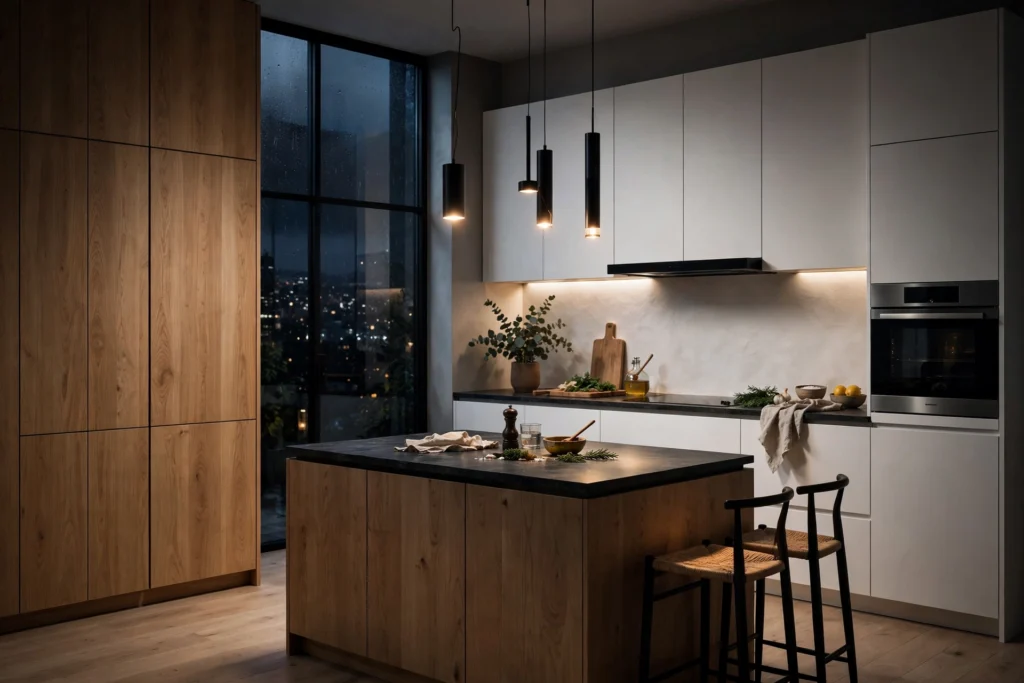
Strip it down to basics: modern kitchen cabinets have one job, and that’s getting rid of visual noise. No raised panels, no fussy trim, no busy molding profiles. What you get instead is clean geometry — flat fronts, straight lines, long uninterrupted runs of cabinetry that make even a cramped galley kitchen feel bigger. It’s why modern kitchens photograph so well. It’s also why they’re genuinely easier to keep clean than anything with grooves and crevices, a point that matters a whole lot more at 7am with sticky toddler hands than it does in a showroom.
One quick honesty note before we go further: “modern” and “contemporary” get used interchangeably, even by cabinet sellers. Strictly speaking, modern refers to the mid-century design movement and contemporary means “what’s current right now.” Nobody in a kitchen showroom enforces that distinction. I’ll use both words the way the industry does — as the same clean, minimal look.
What Makes Kitchen Cabinets Look Modern
There are five signatures, and they work as a package. Miss two or three of them and the kitchen reads “updated” rather than modern.
1. Flat-panel (slab) doors. This is the single biggest signal. A slab door is one smooth, flat piece with no frame, no raised center panel, nothing carved into it. If you remember one thing from this guide, make it this: slab doors = modern.
2. Minimal or invisible hardware. Handles are either slim and simple — think 6 to 12-inch bar pulls — or gone entirely. Handleless cabinets use push-to-open latches, touch latches, or an integrated finger channel routed into the top of the door so you can hook your fingers behind it. The Gola profile (a horizontal channel built into the cabinet frame) is the classic European version of this.
3. Frameless construction. Most modern cabinets are built European-style: the box has no face frame, and the doors sit edge-to-edge with gaps of about 1/8 inch. That tight, continuous surface is a huge part of the look. Framed cabinets with full-overlay doors can pass, but frameless is the native language of modern design.
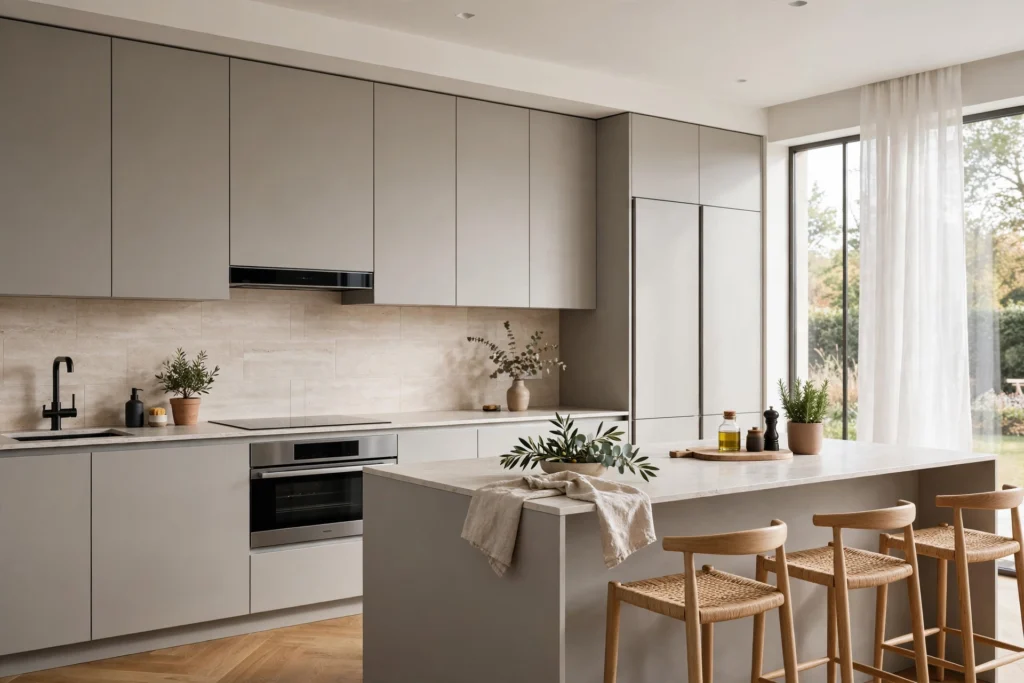
4. A restrained color palette. White, light gray, warm greige, matte black, natural wood tones. One bold color used sparingly (often the island) is fine. Four colors is not modern — it’s a circus.
5. Integrated everything. Appliances disappear behind cabinet panels, the range hood is either a sleek chimney or hidden entirely, and the backsplash is often a full-height slab of the same material as the countertop. The goal is fewer interruptions, more flow.
Modern Cabinet Door Styles
Slab is the headline act, but there are a few variations worth knowing:
- Standard slab (flat panel). Matte or satin finish, any color. The workhorse of modern kitchens. Cheapest to manufacture, easiest to clean, hardest to get wrong.
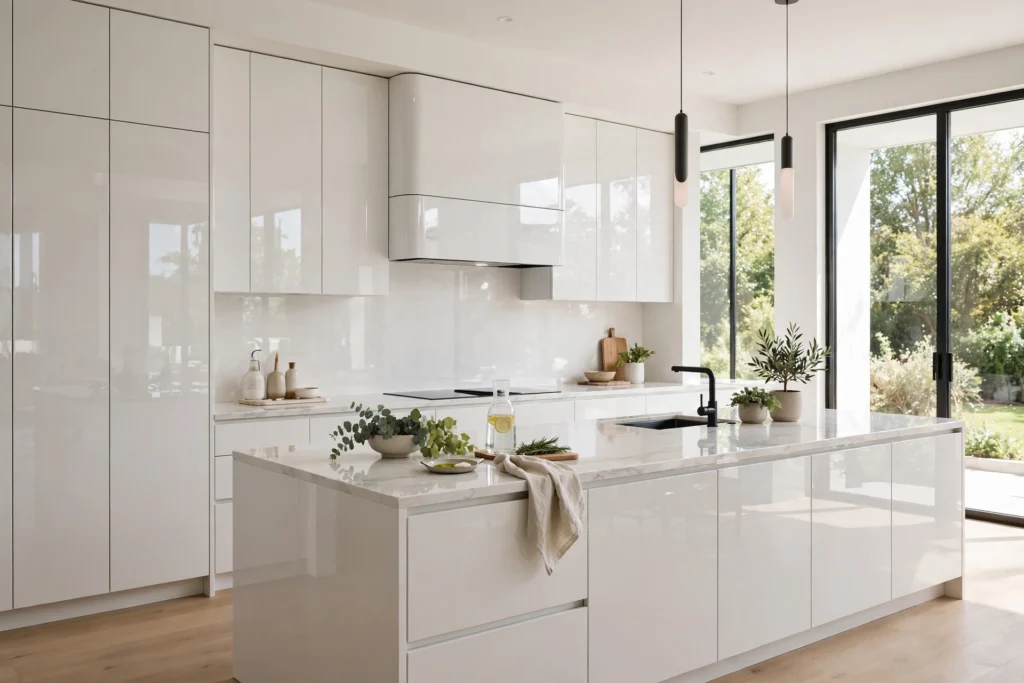
- High-gloss slab. Same flat door, but with a mirror-like acrylic or lacquer finish that bounces light around the room. Gorgeous in the right kitchen — and I mean the right kitchen. High gloss shows every fingerprint, every smudge, every crumb of dust. If you’ve got kids or you cook with a lot of oil, be honest with yourself before choosing it.
- Textured slab. Wood-grain melamine or embossed laminate that looks and feels like real wood or stone at a fraction of the price. The texture adds warmth without adding visual clutter, which is why it’s quietly become one of the most popular modern finishes.
- Modern inset. Inset doors (set flush inside the frame) are usually filed under traditional, but a flat-panel inset door in a dark stain or matte black reads surprisingly modern — more craftsman-modern than Scandinavian, but it works.
- Glass-front accents. Used sparingly — one or two cabinets with frosted or reeded glass — they break up long runs of solid doors and give you somewhere to display the nice dishes. Clear glass shows clutter, so frosted is the safer call.
Materials and Finishes: What Modern Cabinets Are Actually Made Of
Here’s where budgets get decided. The door material matters more than the box material for both looks and price.
- Laminate. The budget champion. A printed or solid-color layer fused to MDF or particleboard. Modern laminates look far better than the 1980s stuff — matte finishes especially. Expect to pay the least per linear foot here.
- Thermofoil. A vinyl film heat-shrunk over MDF. Smooth, seamless, cheap. The catch: it can peel near heat sources (ovens, toasters, dishwashers) over time. Fine for most kitchens, risky right next to a range.
- Acrylic. The high-gloss (and increasingly, super-matte) premium option. Acrylic doors have incredible color depth and are more scratch-resistant than lacquer. They’re also the priciest of the manufactured finishes.
- Lacquer/painted. Sprayed finish over MDF or wood. Smooth, repairable, available in any color. Quality varies wildly — a good spray job is glass-smooth; a bad one shows orange-peel texture up close.
- Wood veneer. Real wood sliced thin and applied to a stable core. You get genuine wood grain with a modern flat door. Walnut, white oak, and rift-sawn oak are the current favorites. I’ve got a full breakdown of wood species, stains, and costs in my wood kitchen cabinets guide.
- Solid wood. Possible in a modern kitchen (flat-panel walnut doors are stunning) but expensive, and solid wood moves with humidity — veneer over a stable core is usually the smarter play for big flat surfaces.
My honest take: for most people, the sweet spot is a matte laminate or painted MDF slab door. You get 90% of the modern look at the most reasonable price, and you won’t spend your weekends polishing fingerprints off acrylic.
Colors That Actually Work in a Modern Kitchen
White is the default for a reason — it reflects light, makes small kitchens feel bigger, and never fights with anything. But “modern” doesn’t have to mean “all white”:
- White and off-white: the safe, timeless pick. Warm whites (not blue-white) look better in most homes.
- Light gray and greige: the 2010s favorite that stuck around because it works. Gray hides wear better than white.
- Matte black / charcoal: dramatic, sophisticated, and very current. Works best in kitchens with good natural light or strong task lighting — in a dark kitchen it can feel like a cave.
- Natural wood tones: white oak and walnut bring warmth to the minimal look. A wood island with white perimeter cabinets is one of the most reliable modern combinations there is.
- Navy and deep green: bold but increasingly mainstream. Keep them to the island or lower cabinets with light uppers.
One design rule that never fails: keep the perimeter light and put the dark color on the island, or go dark on the bottom and light on top. Dark everywhere demands a big, bright room.
Hardware: Small Details, Big Difference
If the doors are the face of the kitchen, hardware is the jewelry. In a modern kitchen, the jewelry should be quiet:
- Handleless: push-to-open latches or integrated finger channels. Cleanest look, slightly less practical — push latches need occasional adjustment and finger channels collect crumbs. Worth it for the look, in my opinion.
- Slim bar pulls: 6, 8, or 12 inches long, about 1/2 inch in diameter. Mounted horizontally on drawers, vertically on doors.
- Edge pulls: small tabs that sit on the top edge of the door. Nearly invisible from across the room.
- Finishes: matte black is the current default, brushed brass or champagne bronze adds warmth, polished chrome feels a bit dated in modern kitchens (it reads more 2000s transitional now).
Whatever you pick, use it consistently. Mixing three finishes is the fastest way to make a modern kitchen look accidental.
What Modern Kitchen Cabinets Cost
The style itself doesn’t add much to the price — a slab door is actually cheaper to build than a raised-panel door. What drives cost is the material, the finish, and stock vs. custom:
- Stock modern cabinets (laminate slab, big-box or online): roughly $100–$300 per linear foot installed, or about $3,000–$8,000 for a typical 10×10 kitchen.
- Semi-custom (painted or veneer slab, more sizes and finishes): roughly $150–$650 per linear foot, or $6,000–$15,000 for that same 10×10 kitchen.
- Custom (acrylic, lacquer, real wood veneer, any size): $500–$1,200+ per linear foot, or $15,000–$30,000+ for a full kitchen.
High-gloss acrylic and real-wood veneer sit at the top of each tier. Handleless systems (push latches, Gola channels) add a modest premium — figure an extra few hundred dollars on a full kitchen, which is cheap for how much cleaner the result looks.
If you want the full picture on budgeting — what drives prices up, where to save, stock vs. RTA vs. custom — my kitchen cabinets buying guide walks through all of it.
Design Tips That Make a Modern Kitchen Look Expensive
You don’t need a custom budget to get the high-end look. A few moves do most of the work:
- Go handleless on at least the uppers. Even if you use bar pulls on the base cabinets, handleless wall cabinets read instantly more modern.
- Run the backsplash full-height. Taking the same slab from countertop to wall cabinet (or ceiling) instead of a 4-inch strip eliminates a visual break. It’s one of the cheapest upgrades with the biggest payoff.
- Add under-cabinet lighting. LED strips under every wall cabinet. This is non-negotiable in a modern kitchen — it makes the counters usable, the backsplash glow, and the whole room feel finished. Warm white (2700–3000K), not blue-white.
- Consider a waterfall island. The countertop material wrapping down the sides of the island is a signature modern move. It costs more in stone, but the impact is enormous.
- Use open shelving sparingly. One or two floating shelves, not a whole wall. Open shelves in a modern kitchen are for the three beautiful things you own, not the mismatched mugs.
- Match the flooring to the mood. Large-format tile or wide-plank wood with minimal grout lines keeps the clean aesthetic going underfoot. Here’s my full rundown of kitchen flooring options if you’re choosing both at once.
Mistakes to Avoid
- Too much high gloss. A full kitchen of mirror-finish doors looks incredible in photos and exhausting in real life. If you love gloss, use it on the island or uppers only.
- Trendy colors on everything. That deep green is beautiful. It’s also a lot less beautiful when you’re tired of it in six years and it’s on every cabinet. Bold color on the island, neutral everywhere else.
- Skipping the lighting. A modern kitchen with bad lighting just looks flat and gray. Budget for under-cabinet LEDs from day one.
- Mixing door styles. Slab doors on the perimeter and shaker on the island doesn’t read “eclectic” — it reads “we ran out of money.” Pick one door style per kitchen.
- Forgetting the ceiling. In a modern kitchen, wall cabinets that stop 12 inches below the ceiling collect dust and look unfinished. Either run cabinets to the ceiling or add a bulkhead/soffit treatment.
Modern Kitchen Cabinets: FAQs
What’s the difference between modern and contemporary kitchen cabinets?
Technically, modern refers to the mid-century design movement and contemporary means current trends. In practice, cabinet sellers and designers use them interchangeably to mean the same thing: clean lines, flat panels, minimal ornamentation.
Are modern kitchen cabinets more expensive?
Not inherently. Slab doors are simpler to manufacture than raised-panel doors, so at the same quality tier, modern cabinets often cost slightly less. Premium finishes like acrylic and real wood veneer push prices up, but that’s a material choice, not a style tax.
What is the most popular modern kitchen cabinet color?
White, by a wide margin — followed by gray, greige, and natural wood tones. Matte black and navy are the popular bold choices, usually on the island or lower cabinets rather than the whole kitchen.
Do modern cabinets have handles?
Many don’t. Handleless designs use push-to-open latches or integrated finger channels. When modern cabinets do have handles, they’re slim bar pulls or edge pulls in matte black, brushed brass, or stainless.
Are flat-panel cabinets hard to keep clean?
They’re the easiest cabinet style to clean — no grooves or raised panels for grease to hide in. High-gloss finishes are the exception; they show fingerprints and need frequent wiping.
Will modern kitchen cabinets go out of style?
The core of the look — flat panels, neutral colors, clean lines — has been around for decades and isn’t going anywhere. Specific trends (all-gray everything, open shelving walls) cycle in and out, so keep the trendy moves to easily changed elements.
The modern look rewards restraint. Pick a flat door, keep the palette tight, hide the clutter, light it well — and the kitchen basically designs itself. Start with the door style and finish that fits your budget, and let everything else follow from there.