
Let’s be honest about the word “cheap.” Nobody wants cheap-looking cabinets — they want cabinets that cost less without announcing it. The good news: the gap between budget and mid-range cabinets has never been smaller. A $3,000 set of well-chosen budget cabinets, properly installed with decent hardware, can look remarkably close to cabinets costing three times as much.
The bad news: the bottom of the market is a minefield of particleboard boxes, peeling thermofoil, and “clearance” deals that aren’t deals at all. This guide maps the real budget options — what each price tier actually gets you, where to save versus where cheap bites back, and the specific moves that make inexpensive cabinets look expensive.
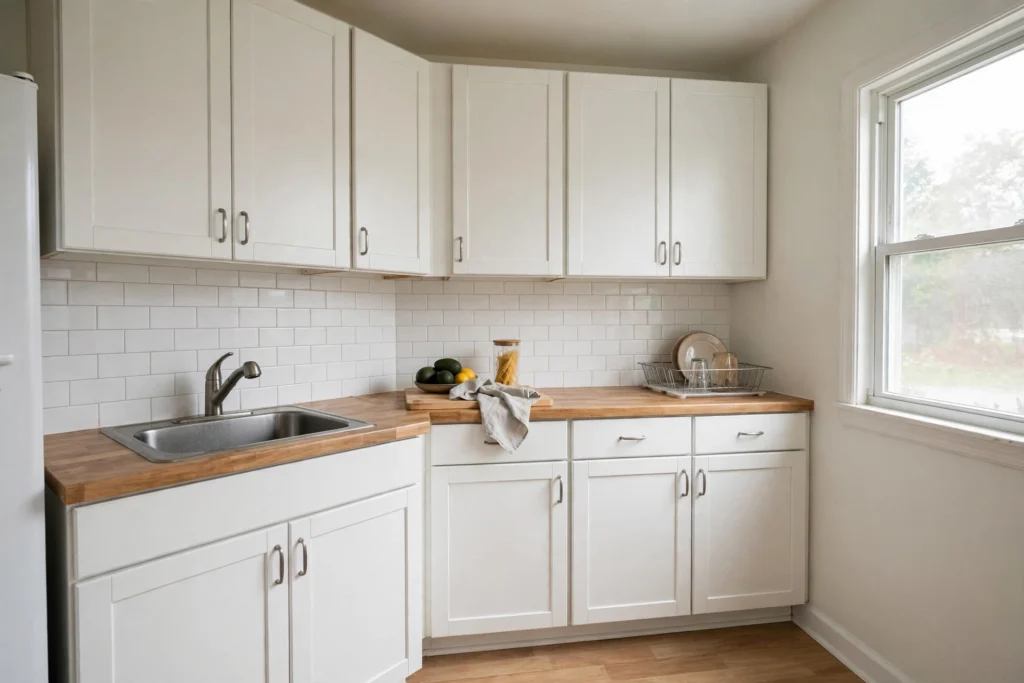
What “Cheap” Gets You at Each Price Point
For a standard 10×10 kitchen (about 20 linear feet of cabinets), here’s the honest landscape:
Under $2,000 — the danger zone. This is used cabinets, deep-clearance stock, and the cheapest flat-pack lines. Deals exist here, but so do most of the horror stories. Everything in this tier needs careful inspection — you’re buying someone’s problem or a discontinued line with no replacement parts.
$2,000–4,000 — the value sweet spot. Budget RTA kitchen cabinets, sale-priced stock cabinets from big-box stores, and in-stock lines from online retailers. All-plywood RTA in this range is genuinely good cabinetry — this is where smart budget remodels live.
$4,000–7,000 — budget-plus. Mid-range RTA, stock cabinets at regular price with nicer door styles, or sale-priced semi-custom. At this level you’re choosing between more style options and better finishes rather than worrying about structural quality.
The biggest quality jump in all of cabinetry happens between $1,500 and $3,000. Below that, you’re gambling. Above $3,000 (in RTA or on sale), you’re buying real cabinets. Keep that threshold in mind — it’s the most useful number in this guide.
The Best Cheap Cabinet Options, Ranked
1. RTA cabinets on sale — best overall value
Budget RTA lines run $2,500–4,000 for a 10×10 kitchen at regular price, and the major online retailers run promotions constantly — 10–20% off sales are normal, holiday weekends go deeper. A $3,200 RTA kitchen at 15% off is $2,720 for all-plywood boxes with soft-close hardware. Nothing else in cabinetry touches that value.
The catch is assembly time (15–25 hours for a full kitchen) and freight shipping ($200–500). Even so, RTA is the default recommendation for budget remodels. Our RTA guide covers quality checks and assembly in detail.
2. Big-box stock cabinets on clearance or sale
Home Depot and Lowe’s run cabinet sales several times a year — typically 20–30% off, sometimes with free installation promotions. Stock lines like Hampton Bay or American Woodmark’s entry tiers are perfectly decent: furniture-board boxes with solid wood doors, factory finishes, real warranties.
The clearance section is where it gets interesting. Discontinued door styles and cancelled special orders get marked down 40–70%. If a cancelled order happens to match your kitchen’s sizes, you can furnish a whole kitchen for pennies. It’s luck-dependent, but worth checking if your timeline is flexible. Ask the kitchen department staff directly — the best clearance deals often aren’t well displayed.
3. In-stock cabinets from online wholesalers
Several online wholesalers sell in-stock (not made-to-order) cabinet lines at near-RTA prices, pre-assembled. You’re trading style selection for convenience — usually 3–6 door styles in white, gray, and espresso. For rental properties, flips, or anyone who just wants clean and simple, this is the fastest path: order Monday, install the next week.
4. Used cabinets — highest risk, lowest cost
Habitat for Humanity ReStores, Craigslist, Facebook Marketplace, and demolition salvage yards regularly list full kitchen cabinet sets for $200–1,000. Sometimes they’re genuinely nice cabinets from a high-end remodel — rich people renovate perfectly good kitchens, and their castoffs are your treasure.
But go in with eyes open: measure everything twice (used sets rarely match standard layouts), check every box for water damage (especially sink bases), and confirm you can get all the pieces — missing one wall cabinet in a discontinued line is a project-killer. Budget for new hinges, pulls, and probably paint. Used cabinets plus a pro paint job ($3,000–5,000) can still come in under new stock pricing.
5. Open shelving instead of upper cabinets — the radical saver
Skipping wall cabinets entirely and using open shelves saves $1,000–3,000 and it’s a legitimate design choice, not just a budget hack. Thick floating shelves ($30–80 each) with nice brackets look intentional and modern. The tradeoff: everything’s visible, so it’s for people who own attractive dishes and don’t mind dusting. Pair with budget base cabinets and the kitchen looks designed, not deprived.
Where to Save vs. Where Cheap Bites Back
Save on: the door style (simple Shaker looks expensive in any price tier — ornate styles look cheap when done cheaply), the finish color (white and gray hide a multitude of sins; dark stains show every flaw), decorative extras (skip the corbels, the fancy range hood, the glass doors — clean and simple reads as modern), and brand names (a $3,000 RTA kitchen and a $6,000 big-box kitchen are often the same quality).
Don’t cheap out on:
- Box material. Plywood over particleboard, always. A $500 savings on particleboard boxes costs you the whole kitchen when the sink base swells. This is the one non-negotiable.
- Hardware. Soft-close hinges and full-extension drawer slides cost maybe $200 more across a whole kitchen and they’re the difference between “budget” and “feels budget.” This is the highest-ROI upgrade in cheap cabinets.
- Installation. Badly installed good cabinets look worse than well-installed cheap ones. Level, plumb, square, properly shimmed, screwed into studs — installation quality is visible in every door gap. If you’re not confident, this is where to spend.
- The sink base. Whatever you do, don’t put a particleboard sink base under your plumbing. Water finds a way. Plywood sink base or nothing.
Discount, Wholesale, and Clearance: Reading the Fine Print
“Wholesale” kitchen cabinets are mostly a marketing term — true wholesale requires a contractor license and volume. What consumers find under “wholesale” is usually just RTA at RTA prices with a fancier name. Compare the actual specs, not the label.
Clearance and “kitchen cabinets on sale” deserve a skeptical eye. A permanent “SALE — 50% OFF!” sign is just the price. Real deals: discontinued lines (verify replacement doors will be available for at least a few years), cancelled special orders in your sizes, and floor models. Ask why it’s discounted — the answer tells you everything.
Red flags at any price: no stated box material in the specs, “some assembly required” with no brand name attached, sellers who won’t send a door sample, prices under $1,500 for a full kitchen (the materials alone cost more than that — something’s wrong), and “all sales final” on sight-unseen orders.
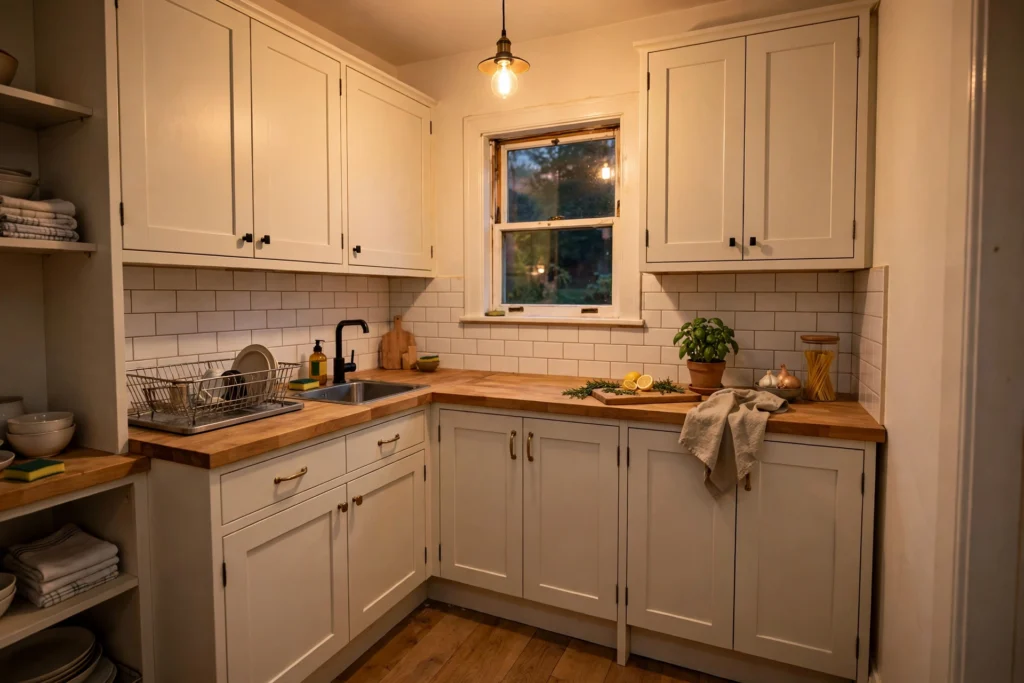
Making Cheap Cabinets Look Expensive: The $500 Difference
Here’s the part the cabinet industry doesn’t advertise: the visible difference between $3,000 cabinets and $10,000 cabinets is about $500 in details.
- Crown molding and trim ($150–300): A simple crown at the top of wall cabinets and light rail underneath transforms stock boxes into built-in-looking cabinetry. Our crown molding guide walks through it.
- Upgraded pulls and knobs ($100–200): Swap the included basic knobs for solid bar pulls or cup pulls. It’s jewelry for cabinets — disproportionate impact.
- Under-cabinet lighting ($50–150): LED strips under wall cabinets make any kitchen feel high-end and cost almost nothing now.
- A furniture toe kick or finished end panels ($50–100): Skin the exposed cabinet sides with matching panels so you don’t see raw box sides at the end of a run.
- Soft-close everything ($100–200 if not included): Already covered, but it bears repeating — the feel of a soft-close drawer reads as “expensive” to everyone who touches it.
Do those five things to a $3,000 RTA kitchen and guests will guess $12,000. I’m not exaggerating — I’ve watched it happen.
Timing Your Purchase: When Cabinets Are Cheapest
Cabinet pricing is seasonal. The deepest discounts cluster around:
- Holiday weekends: Memorial Day, July 4th, Labor Day, Black Friday — the big-box 20–30% off sales.
- January–February: The post-holiday remodeling lull. Retailers discount to move inventory; contractors are available and sometimes cheaper too.
- End of model year: When lines discontinue door styles (usually fall), clearance pricing hits.
If your remodel timeline is flexible, buying cabinets 2–3 months before you need them during a sale window and storing them flat in the garage can save 20–30%. Just don’t demo the kitchen until the cabinets are physically in your possession — backorders during sale events are common.
Frequently Asked Questions
What are the cheapest kitchen cabinets that are still good? Budget RTA cabinets at $2,500–4,000 for a 10×10 kitchen are the cheapest good option — all-plywood boxes, soft-close hardware, real warranties. Below $2,000 you’re in used-cabinet or deep-clearance territory, where quality is a case-by-case gamble.
Is it cheaper to buy cabinets at Home Depot or online? Usually online, for comparable quality. Online RTA retailers run 20–40% cheaper than big-box stock lines of similar quality because they skip the retail markup. Big-box wins on convenience (see it in person, faster delivery) and during major sale events with installation promotions — always compare the out-the-door price including delivery and install.
Can I get quality kitchen cabinets for under $3,000? Yes — a 10×10 kitchen in budget RTA with plywood boxes lands around $2,500–3,000 before installation. Add DIY assembly and installation and the whole cabinet package stays under $3,500. The key is buying during a sale and doing the labor yourself.
Are cheap cabinets worth it for a rental property? Absolutely — rentals are the ideal use case for budget cabinets. Tenants don’t need (and won’t maintain) premium finishes. Budget RTA or stock in a durable white finish, plywood sink base, and decent hardware will survive a decade of tenants. Save the custom work for your own kitchen.
Should I buy used kitchen cabinets? Only if you can inspect them in person, they fit your layout (or close enough), and the price leaves room for new hardware and paint. Great used sets exist — full kitchens for $200–1,000 from high-end remodels — but water damage, missing pieces, and non-standard sizes kill most deals. Never buy used sight unseen.
How do cabinet costs fit into a full kitchen remodel budget? Cabinets typically eat 30–40% of a kitchen remodel budget — the biggest single line item. Our kitchen cabinet costs guide breaks down the full picture, and if you’re weighing whether to replace at all versus remodeling what you have, that guide compares painting, refacing, and replacement head to head.