
There’s a strip of dead space in most kitchens — the 12 to 24 inches between the top of the wall cabinets and the ceiling — and it drives people crazy. Too visible to ignore, too awkward to use, too high to reach without a step stool. So it becomes either a dusty graveyard of forgotten decor or a source of low-grade guilt every time you look up.
Here’s the liberating truth: there’s no rule that says you have to decorate above your kitchen cabinets at all. Some of the best-looking kitchens leave it empty. But if the blank space bothers you, there are genuinely good ways to handle it — and some genuinely bad ones. This guide covers 20+ ideas, the styling rules that make them work, what to avoid, and the dust situation (because that’s really what this is about).
Should You Decorate Above Kitchen Cabinets? An Honest Answer
Leave it empty if: your ceilings are 8 feet with 42″ cabinets (the gap is small and crown molding finishes it fine), your kitchen is modern or minimalist (empty reads as intentional), you hate dusting, or anything you put up there will just stress you out. Empty is a choice, not a failure.
Decorate it if: the gap is large (18″+, common with 30″ cabinets on 8-foot ceilings or any cabinets on 9–10 foot ceilings), the blank space genuinely bothers you, or your kitchen style is traditional, farmhouse, or collected — styles where displayed objects look at home.
The third option nobody mentions: close the gap. A soffit, a frieze board with crown molding, or stacked cabinets eliminate the space entirely. If you’re remodeling anyway, 42″ cabinets to the ceiling (or a built soffit above 36″ cabinets) removes the question permanently. It’s the cleanest solution and it adds storage.
The Styling Rules (Read Before Buying Anything)
Whatever you put up there, these rules separate “styled” from “cluttered”:
1. Scale up or go home. Small objects disappear up there and read as clutter. The #1 mistake is a row of tiny knick-knacks. Everything above cabinets should be large — oversized baskets, big platters, substantial plants. If it’s smaller than a dinner plate, it probably doesn’t belong.
2. Odd numbers and repetition. Groups of 3 or 5, with a repeated element (same material, same color family) tying them together. Five matching baskets in a row looks intentional; five random objects looks like a yard sale.
3. Vary the heights. A flat row of same-height objects looks like a police lineup. Mix tall, medium, and low — or use risers and stacked books under shorter pieces to create a varied skyline.
4. Leave breathing room. Don’t fill every inch. Negative space between groupings is what makes it look styled rather than stuffed. Aim to fill 50–70% of the run, max.
5. Match the kitchen’s style. Farmhouse kitchen? Baskets, crocks, wooden bowls. Traditional? Brass, copper, classic platters. Modern? Honestly, modern kitchens usually look best with the space empty or with one sculptural piece — modern and “stuff on top of cabinets” don’t mix well.
6. Consider the sight lines. You see this space from across the room and from the adjacent living area. Style it for distance, not for close inspection — bold shapes and colors read; fine details don’t.
20+ Ideas for Above Kitchen Cabinet Decor
Greenery (the classic for a reason)
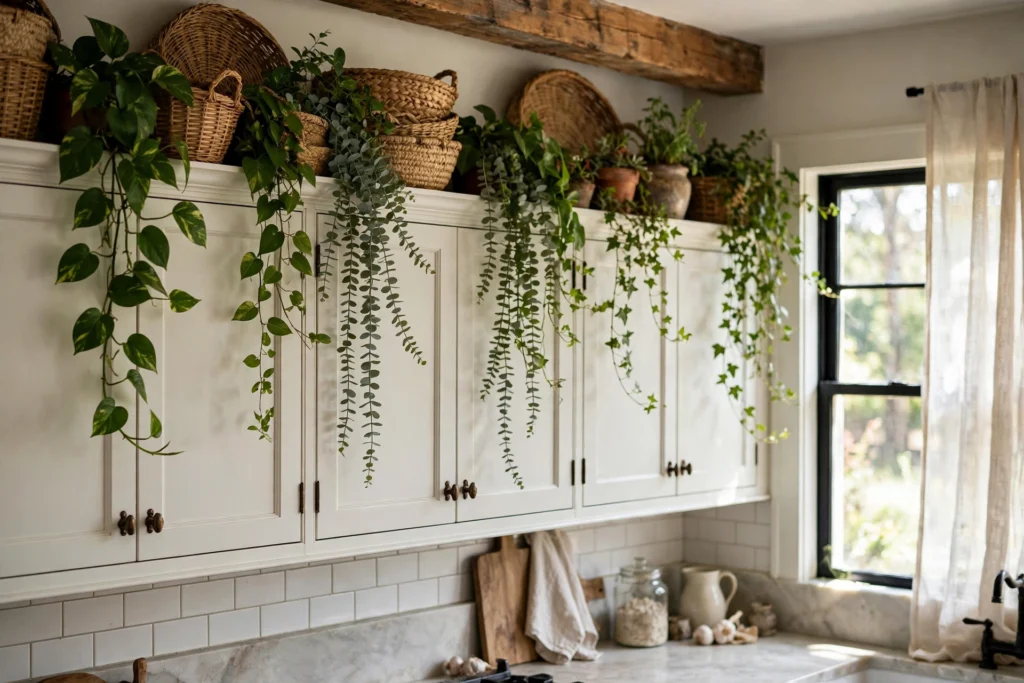
1. Trailing pothos or philodendron. The all-time champion of above-cabinet decor. Buy 3–5 plants in matching pots, space them along the run, and let them trail down over the cabinet fronts. They’re nearly unkillable, they thrive on neglect, and the trailing green softens the hard cabinet lines. Water every 1–2 weeks — set a phone reminder, because you will forget they’re up there.
2. Faux trailing plants. No shame in this. Good faux pothos ($15–30 per plant) looks convincing from six feet below, never needs water, and never dies while you’re on vacation. The key word is good — cheap shiny plastic plants look cheap. Spend the extra $10.
3. A row of small potted herbs (faux). Real herbs won’t get enough light up there. Faux herbs in matching terracotta pots give the farmhouse look without the slow death.
Baskets and natural textures
4. Oversized woven baskets. Large seagrass or wicker baskets (18″+ wide) laid on their sides or standing upright. The texture contrasts beautifully with smooth cabinet fronts. Group 3–5 in varying sizes.
5. Woven trays and chargers. Flat woven pieces leaned against the wall behind shorter objects add layered texture. Inexpensive, lightweight, and easy to dust.
6. Wooden dough bowls and bread boards. The farmhouse staple. A collection of wooden bowls, cutting boards, and rolling pins in natural wood tones looks warm and collected. Lean boards against the wall, stack bowls.
Kitchen heritage pieces
7. Vintage or vintage-look pitchers and crocks. Stoneware crocks, enamel pitchers, copper pots — the “grandmother’s kitchen” collection. Flea markets and thrift stores are the source; a $10 crock from Goodwill beats a $40 new one every time for character.
8. Display-worthy cookware. Copper pots, colorful Le Creuset-style Dutch ovens, a beautiful kettle — things too pretty to hide. This only works if the pieces are genuinely attractive; your dented stockpot is not decor.
9. Antique kitchen tools. Old scales, wooden crates, vintage tins, a butter churn if you’re committed to the bit. Curate hard — three great pieces beat ten mediocre ones.
Plates, platters, and serving pieces
10. Large platters on plate stands. Oversized serving platters (the ones too big for any cabinet) displayed on stands or leaned against the wall. White ironstone or blue-and-white reads classic; hammered metal reads modern-farmhouse.
11. A collection of cutting boards. Lean 3–5 wooden cutting boards of varying sizes and tones against the wall. Simple, warm, practically free if you already own them.
12. Decorative plates. Plate hangers or a plate ledge for display plates. Traditional, a little grandmotherly, but in the right kitchen it’s perfect.
Light and atmosphere
13. LED strip lighting above the cabinets. This is the sleeper hit. A $20–40 LED strip along the top of the cabinets, washing light up the wall to the ceiling, makes the whole kitchen glow in the evening. It also makes whatever decor you do have look dramatically better. Do this even if you decorate minimally — it’s the best $30 in kitchen ambiance.
14. Lanterns or candle holders (LED candles only). Real candles above cabinets are a fire-safety no. LED pillar candles in lanterns give the flicker without the risk. Group in odd numbers.
15. A neon or lettered sign. “Gather,” “Eat,” the family name — the modern farmhouse move. One sign, centered, nothing else competing with it. It’s a look; commit or skip.
Art and architecture
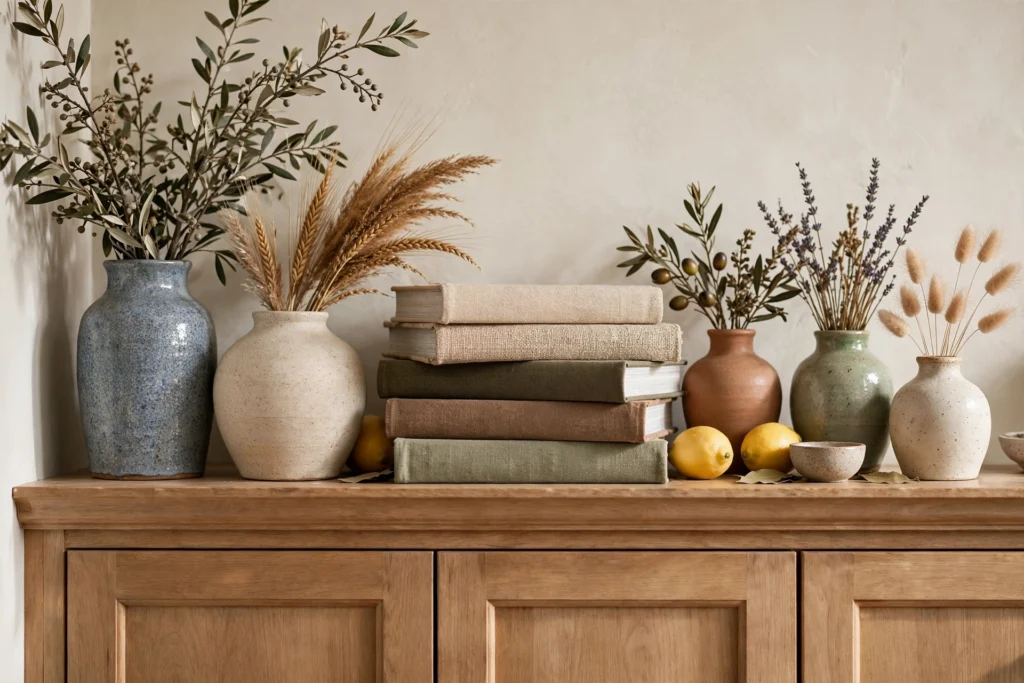
16. Framed art or prints. Lean large framed prints against the wall above the cabinets. Food-themed art, vintage advertisements, botanical prints — whatever suits the kitchen. Big frames, simple mats.
17. Architectural salvage. Corbels, old window frames, a section of tin ceiling tile — pieces with history that add character no new decor can match. One statement piece per run.
18. Cookbooks (display copies). A row of beautiful cookbooks — spines out, maybe with bookends. Use the pretty ones; the stained, falling-apart weeknight bible stays in the cabinet. Bonus: they’re actually up there if you need them (with a step stool).
The bold moves
19. Wallpaper or paint accent on the wall strip. Instead of objects, treat the wall itself: a bold paint color, removable wallpaper, or beadboard on the strip above the cabinets. It defines the space architecturally and collects zero dust. This is the sophisticated answer.
20. Nothing — with great crown molding. The power move. Run substantial crown molding to the ceiling (or add a frieze board), light it with LED strips, and leave the space gloriously empty. It reads as confident and custom, and your future self will thank you every time you don’t have to dust up there.
21. Seasonal rotation. If you must decorate, keep a single bin of seasonal pieces (fall garland, spring greenery, holiday items) and swap 2–3 times a year. The rotation forces regular dusting and keeps it fresh. Store the off-season bin in the space above the cabinets — it’s the perfect use for the unreachable zone.
What Collects Dust (The Honest Dust Audit)
Let’s talk about the real issue: kitchen air is greasy. Cooking puts a fine film of airborne grease on every surface, and above the cabinets — warm air rises — that film mixes with dust into a sticky layer that’s genuinely unpleasant to clean. Anything you put up there will get grimy. The question is how bad and how hard it is to clean.
Worst offenders: fabric items (dried flower arrangements, fabric garlands — they absorb grease and can’t be wiped), intricate objects with lots of crevices (wicker baskets are borderline — they’re wipeable but tedious), anything white or light-colored (shows grime fastest), and paper items.
Easiest to maintain: large smooth objects (ceramic platters, glass, metal — wipe with a damp cloth in seconds), faux plants (take them down twice a year and rinse in the shower), and LED lighting (no decor to dust at all).
The practical compromise: if you decorate, commit to a twice-yearly cleaning — take everything down, wipe the cabinet tops (you’ll be horrified the first time), wipe each piece, put it back. Twenty minutes, twice a year. If that sounds unbearable, choose the empty-with-crown-molding option and never think about it again.
What NOT to Put Above Kitchen Cabinets
- Anything valuable or irreplaceable. Heat, grease, and the occasional fall during dusting — this is no place for heirlooms.
- Real candles or anything flammable near heat. Obvious, but people do it.
- Small clutter. The tiny souvenir spoon collection, the shot glasses, the miniature anything. It reads as mess from below.
- Fake food displays. The dusty plastic fruit bowl is the #1 dated-kitchen tell. Retire it.
- Anything you need regularly. If you use it weekly, it doesn’t live on top of the cabinets. That’s just self-inflicted inconvenience.
- A random single object. One lonely item in a six-foot run looks like you forgot to finish, not like a design choice. Either commit to styling the run or leave it empty.
Making It Work With Your Cabinet Style
White/Shaker cabinets: Almost anything works — the neutral background is forgiving. Greenery, natural wood, and black accents all pop against white.
Dark cabinets (navy, green, black): Go lighter and brighter up top — light baskets, white ceramics, greenery. Dark objects on dark cabinets disappear.
Wood cabinets: Match the warmth — brass, copper, warm ceramics, natural fibers. Avoid competing wood tones that clash with the cabinet finish.
Modern flat-panel cabinets: Less is more. One sculptural object, LED lighting, or nothing. The clean lines are the feature; don’t fight them.
For more on choosing and styling your cabinets themselves, our kitchen cabinets buying guide covers styles and finishes — and if your wall cabinets are the issue (too short, leaving a huge gap), our wall cabinets guide covers sizing options including 42″ cabinets that minimize the gap.
Frequently Asked Questions
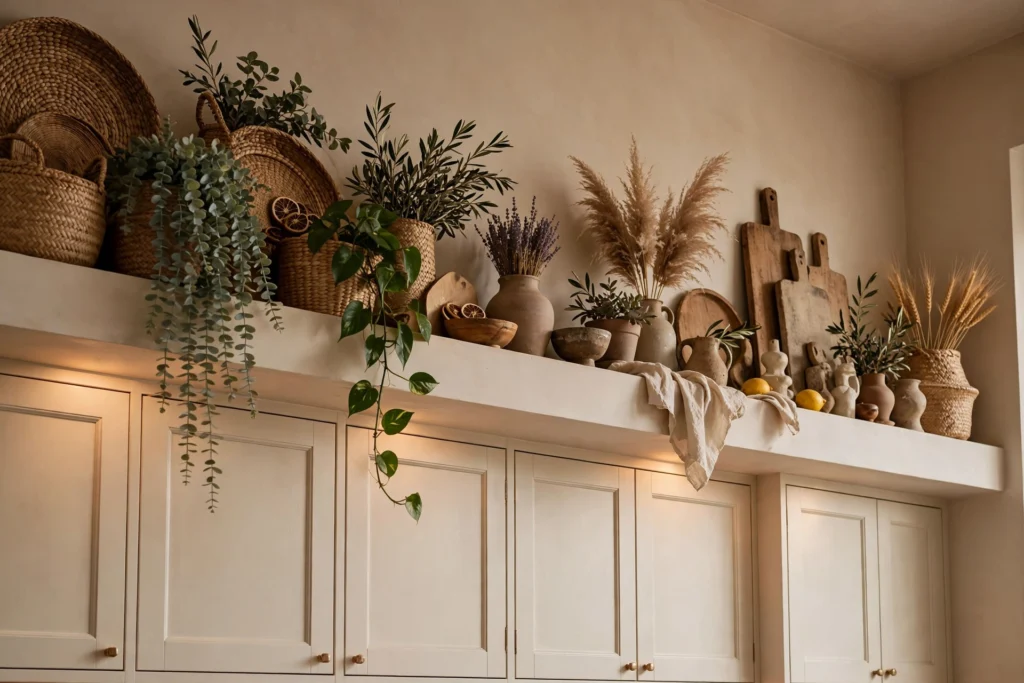
How do I decorate the space above my kitchen cabinets? Use large-scale items in odd-numbered groupings with varied heights: trailing plants, oversized baskets, vintage crocks, large platters, or cookbooks. Match the style to your kitchen, leave breathing room between groupings, and style for distance — bold shapes read from across the room, fine details don’t.
Should I put anything above my kitchen cabinets? Not necessarily — empty with good crown molding is a legitimate, sophisticated choice, especially in modern kitchens. Decorate if the gap is large (18″+) and the blank space bothers you; leave it empty if you hate dusting or prefer a clean look. There’s no design law requiring decor up there.
How do you keep decorations above kitchen cabinets from getting dusty? Choose large, smooth, wipeable objects (ceramics, glass, metal) over fabric or intricate pieces. Commit to taking everything down twice a year for a full wipe-down of both the decor and the cabinet tops. Faux plants can be rinsed in the shower. Or eliminate the problem: LED strip lighting with minimal decor collects almost nothing.
What is the trend for decorating above kitchen cabinets? The current trend is restraint: fewer, larger pieces; LED accent lighting; or closing the gap entirely with stacked cabinets or soffits during remodels. The maximalist “fill every inch” look of the 2000s (looking at you, dusty plastic ivy) is firmly out.
Can I put plants above kitchen cabinets? Yes — trailing pothos and philodendron are the classic choice; they’re low-light tolerant and thrive on neglect. Water every 1–2 weeks (set a reminder). If the light is truly terrible or you’ll forget to water, good-quality faux trailing plants look convincing from below and need zero care.
How do I fill a large gap above kitchen cabinets? For gaps over 18″, options include: tall decor (large baskets, oversized art leaned against the wall), a frieze board with crown molding to architecturally close part of the gap, wallpaper or an accent paint color on the wall strip, or — during a remodel — stacking cabinets or building a soffit to eliminate the gap permanently.