
Every kitchen has the same problem: plenty of cabinets, nowhere to put anything. The issue is rarely square footage — it’s that standard cabinets are dumb boxes, and dumb boxes waste roughly a third of their volume on dead corners, unreachable backs, and piles of things stacked on top of each other.
The fix isn’t more cabinets. It’s smarter cabinets: pull-outs that bring the back of the shelf to you, vertical dividers that end the baking-sheet avalanche, pantry cabinets that actually fit your food, and appliance garages that get the toaster off the counter. This guide covers the storage cabinet types worth buying, the organizers that genuinely work (and the ones that don’t), and how to plan storage for small kitchens.
The Storage Problem, Quantified
A standard 24″ deep base cabinet with a fixed shelf holds about 4 cubic feet of theoretical storage. In practice, most people use the front 12 inches and lose the rest to the archaeological layers at the back — the fondue pot from 2019, the bread machine, the cans you can’t identify without excavation.
Pull-out shelves reclaim roughly 80% of that lost depth. A $40 pull-out shelf kit in a base cabinet effectively doubles its usable storage. Across a whole kitchen, smart organizers add the equivalent of 3–5 extra cabinets without changing the footprint. That’s the math that makes a $500 organizer budget the smartest money in a kitchen project.
Pantry Storage Cabinets: The Tall Solution
Tall pantry cabinets — 84″ to 96″ high, 12″ to 24″ deep — are the single highest-capacity storage unit in the kitchen. A single 24″ wide pantry cabinet with pull-out shelves holds more accessible food storage than three standard wall cabinets.
Types worth knowing:
- Pull-out pantry cabinets (12″–18″ wide, full-height pull-out): The narrow tall cabinet that slides out like a drawer. Perfect for the 12″ gap next to the fridge that would otherwise be a filler panel. Holds spices, oils, cans — everything visible at a glance. This is the best use of narrow leftover space in any kitchen.
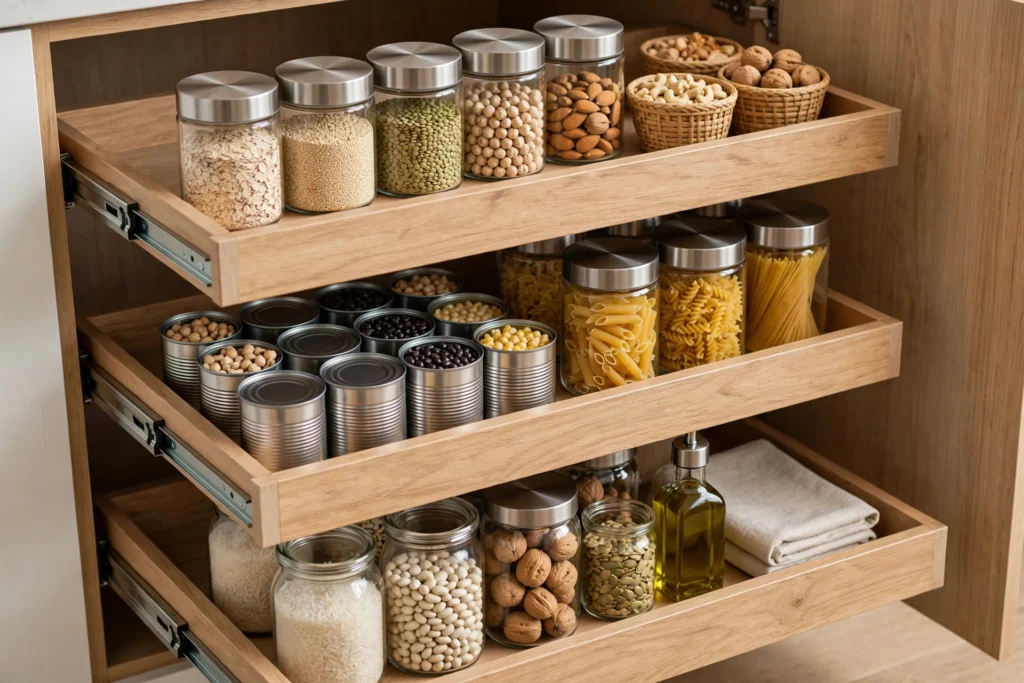
- Pantry cabinets with pull-out shelves (18″–36″ wide): Standard tall cabinet fitted with 3–5 pull-out shelves instead of fixed shelves. Each shelf rolls out to you — no more reaching into the dark. Specify these when ordering; retrofitting pull-outs later costs more.
- Freestanding pantry cabinets: Furniture-style pieces for kitchens without built-in pantry space. The good ones (24″+ wide, real wood, adjustable shelves) run $300–800 and look intentional rather than improvised. Avoid the flimsy $99 flat-pack versions — they wobble and the doors never stay aligned.
- Pantry cabinets with doors and shelves (the classic): Fixed-shelf tall cabinets are the cheapest option but the least functional — deep fixed shelves in a tall cabinet are where food goes to expire. If budget forces fixed shelves, add aftermarket pull-out kits ($30–60 per shelf) immediately.
Sizing guidance: 18″–24″ deep is the practical maximum for pantry cabinets — deeper than that and even pull-outs get unwieldy. 24″ wide is the versatile standard; 12″–15″ for pull-out pantries in narrow gaps; 30″–36″ for the main family pantry.
For the full rundown on pantry-specific options, see our kitchen pantry cabinets guide.
Appliance Garages: Getting the Counter Back
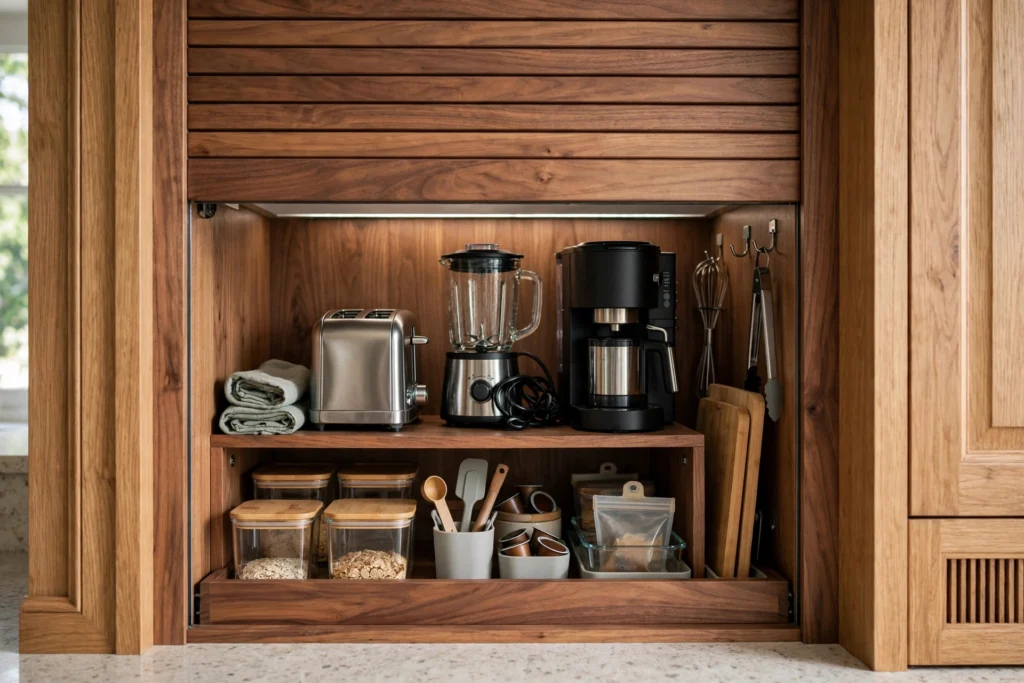
The appliance garage — a countertop-height cabinet with a roll-up or lift-up door — exists for one reason: the toaster, the coffee maker, and the stand mixer are used daily but look like clutter. An appliance garage keeps them plugged in, accessible, and invisible.
What works: A 24″–36″ wide wall-cabinet-depth unit sitting on the counter, ideally in a corner or at the end of a run. Tambour (roll-up) doors are the classic; lift-up doors with soft-close hinges are the modern upgrade and easier to operate. Include an outlet inside — an electrician adds one for $150–300, and it’s the difference between a garage you use and a garage that’s just a cabinet.
What doesn’t: Appliance garages narrower than 18″ (nothing fits), garages without interior outlets (defeats the purpose), and placing them where the open door blocks a walkway.
The stand mixer question: If you own a 25-pound stand mixer, a dedicated mixer lift — a spring-loaded shelf inside a base cabinet that raises the mixer to counter height — is worth every penny of the $150–250 hardware cost. Lifting that thing in and out of a cabinet is how backs get hurt and mixers stop getting used.
Pull-Outs and Organizers That Actually Work
After watching hundreds of kitchens, here’s my honest ranking of interior organizers by actual daily value:
Tier 1 — buy these without hesitation:
- Trash/recycling pull-out ($80–200): The single most life-improving organizer. A double-bin pull-out in a base cabinet near the sink. Once you’ve had one, a freestanding trash can feels barbaric.
- Pull-out shelves in base cabinets ($30–60 each aftermarket): Converts dumb deep cabinets into accessible storage. Do every base cabinet that doesn’t have a specific purpose.
- Drawer dividers and peg systems ($20–50): Deep drawers without dividers become junk drawers within a month. Pegboard-style dividers adapt to whatever you store.
- Spice pull-out ($60–150): A narrow 6″–9″ pull-out next to the range. Spices visible, labeled, reachable — versus the current system of knocking over jars to find the cumin.
Tier 2 — worth it in the right kitchen:
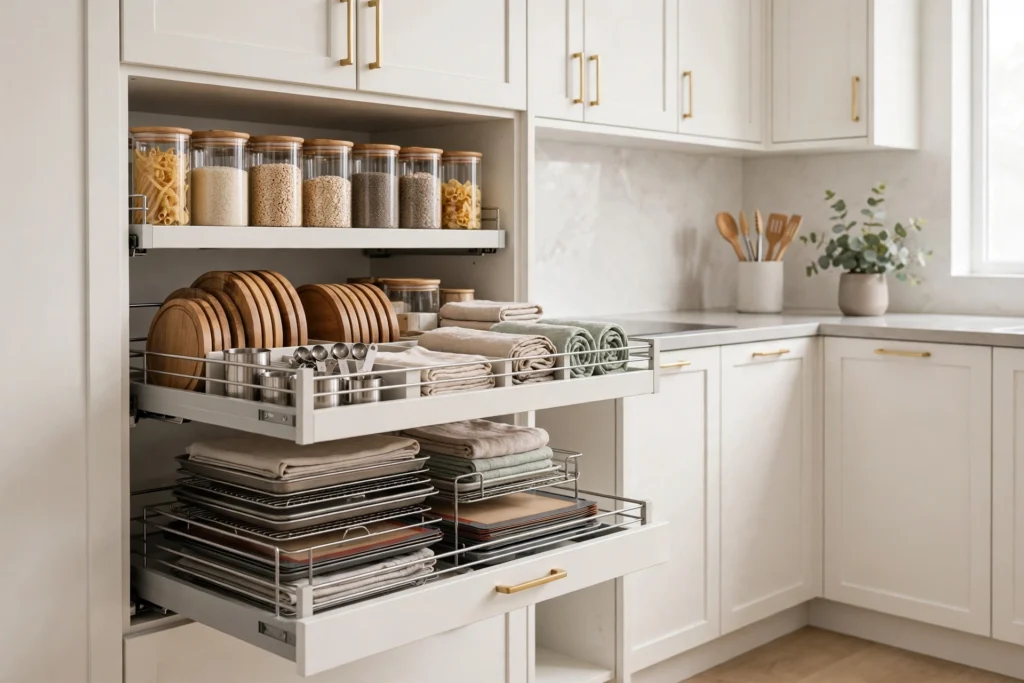
- Tray dividers ($20–40): Vertical slots for baking sheets, cutting boards, and muffin tins. Ends the avalanche. Fits in any 12″+ base cabinet.
- Lazy Susan / super Susan for corner cabinets ($80–250): Corner cabinets are the Bermuda Triangle of kitchens. A kidney-shaped super Susan makes them usable. Not perfect — things still fall off the back — but vastly better than a dark cave.
- Blind-corner pull-out systems ($200–500): The fancy articulated shelves that swing out of blind corners. They work, they’re impressive, and they’re expensive. Worth it if you have a true blind corner; overkill otherwise.
- Under-sink organizer ($30–80): A sliding caddy that works around the plumbing. The under-sink cabinet is inherently awkward — this makes it merely slightly awkward.
Tier 3 — skip unless you have a specific need:
- Wine racks in base cabinets: Look great in photos, hold bottles you’ll never drink, waste prime storage real estate. Unless you’re genuinely into wine, it’s decoration.
- Built-in knife blocks in drawers: Fine, but a $15 magnetic strip on the wall does the same job and frees the drawer.
- Toe-kick drawers: Clever in theory (storage in the toe-kick space!), annoying in practice — you’re on your knees to access them, and they collect every crumb in the kitchen.
- Pull-down shelves for wall cabinets: Designed for accessibility, but the mechanisms are fiddly and they halve the shelf’s capacity. A step stool is cheaper and holds more.
Small Kitchen Storage Cabinets: Doing More With Less
Small kitchens don’t need miniature solutions — they need the standard solutions applied ruthlessly:
- Go tall. A 42″ wall cabinet holds 40% more than a 30″ one in the same footprint. In small kitchens, always max out vertical space — the top shelf is for the stuff you use twice a year.
- One great pantry beats three mediocre cabinets. A single 24″ pull-out pantry cabinet outperforms an entire wall of shallow uppers for actual food storage.
- Drawers over doors in base cabinets. Three deep drawers in a 24″ base cabinet store more — and more accessibly — than a door cabinet with shelves. This is the single best small-kitchen upgrade: specify drawer bases everywhere you can. Our kitchen base cabinets guide covers drawer base configurations.
- Use the backs of doors. $10 over-the-door racks inside pantry and sink cabinet doors hold wraps, spices, and cleaning supplies in otherwise dead space.
- A rolling cart as overflow. A $60–100 rolling kitchen cart parks in a gap, holds the overflow, and moves where you need it. Not glamorous, deeply practical.
Kitchen Hutches and Freestanding Storage
The hutch — a freestanding cabinet with counter-height base and open or glass-front upper — is the furniture answer to storage. In kitchens with an awkward empty wall, a hutch adds 8–12 cubic feet of storage plus display space, and it looks like it belongs in a way that another run of wall cabinets sometimes doesn’t.
Best uses: dining-adjacent walls, breakfast nooks, and kitchens where the built-in storage ran out. Look for hutches 48″–60″ wide with adjustable shelves; the sweet spot is $400–1,200 for solid wood. Glass-front uppers display the good dishes; solid doors hide the chaos. Know which one you are.
Cabinet Shelves: The Unsexy Foundation
Everything above assumes your shelves work. A few fundamentals:
- Adjustable shelves should be standard on every wall cabinet and pantry — fixed shelves are a storage crime. If your cabinets came with fixed shelves, a $15 shelf-pin jig and a drill fixes it in an afternoon.
- Shelf thickness matters: 3/4″ shelves for spans over 24″ (thinner shelves sag under dishes — the slow sag is real and it’s ugly).
- Shelf liners ($10–20 per roll) protect shelves and make cleaning spills bearable. The cushioned non-adhesive kind, not the sticky kind — sticky liner is a regret you’ll peel off in strips for years.
Planning Storage Into a New Kitchen (or Retrofit)
If you’re ordering cabinets, storage planning happens at the design stage — moving a pull-out from the plan to reality later costs triple. Walk through your current kitchen with a notepad and write down every annoyance: the pot you can’t reach, the spice chaos, the trash can in the walkway, the mixer you never use because it’s heavy. Each annoyance maps to a specific organizer. Bring that list to the cabinet designer.
If you’re retrofitting existing cabinets, start with the trash pull-out and pull-out shelves in the two most-used base cabinets. That’s $200–300 and a Saturday, and it changes how the kitchen feels more than any other small project. Then work outward as budget allows.
Frequently Asked Questions
What is the best storage solution for deep kitchen cabinets? Pull-out shelves — full-extension sliding shelves that bring the back of the cabinet to you. At $30–60 per shelf aftermarket, they’re the highest-ROI storage upgrade in the kitchen, effectively doubling the usable space of every deep base cabinet.
How do I organize a small kitchen with limited cabinets? Maximize vertical space (42″ wall cabinets), use one tall pull-out pantry instead of scattered small storage, specify deep drawers over door cabinets in the bases, use door backs for small items, and add a rolling cart for overflow. Small kitchens reward ruthless prioritization over more cabinets.
Are pull-out pantry cabinets worth it? Yes — especially the narrow 12″–18″ full-height pull-outs that fit in gaps next to the fridge or range. Everything is visible and reachable, nothing expires in the back. They’re among the most-used organizers in any kitchen that has one.
What should I put in an appliance garage? Daily-use appliances you don’t want to look at: toaster, coffee maker, stand mixer (or give the mixer its own lift cabinet). Include an interior outlet so everything stays plugged in. Skip storing rarely-used appliances there — that’s what the pantry is for.
How much do kitchen cabinet organizers cost? Budget $300–800 to properly outfit a 10×10 kitchen with the essentials: trash pull-out ($80–200), pull-out shelves for 4–6 base cabinets ($30–60 each), drawer dividers ($20–50), and a spice pull-out ($60–150). Specifying organizers when ordering new cabinets is cheaper than retrofitting later.
What’s the difference between a pantry cabinet and regular storage cabinets? Pantry cabinets are tall (84″–96″) floor-to-near-ceiling units designed for food storage, while “storage cabinets” as a general term is the broader category covering all cabinet storage. A pantry cabinet is one type of storage cabinet. Our pantry cabinets guide goes deep on pantry-specific options.