
Picking flooring feels like it should be simple — it’s the stuff you walk on — until you’re standing in a showroom staring at forty samples that all look sort of like wood. Then the salesperson starts talking about wear layers and AC ratings, and suddenly you’re Googling on your phone in the aisle, more confused than when you walked in.
Here’s the thing nobody tells you upfront: there are really only six main types of flooring worth considering for a home. Six. Everything else is a variation. And each one has a distinct personality — what it does well, where it falls apart, what it costs, how long it lasts. Once you know those personalities, the decision gets dramatically easier.
This guide compares them all — hardwood, vinyl, laminate, tile, linoleum, and carpet — with honest pros, cons, and real cost ranges. No sponsored picks, no fluff.
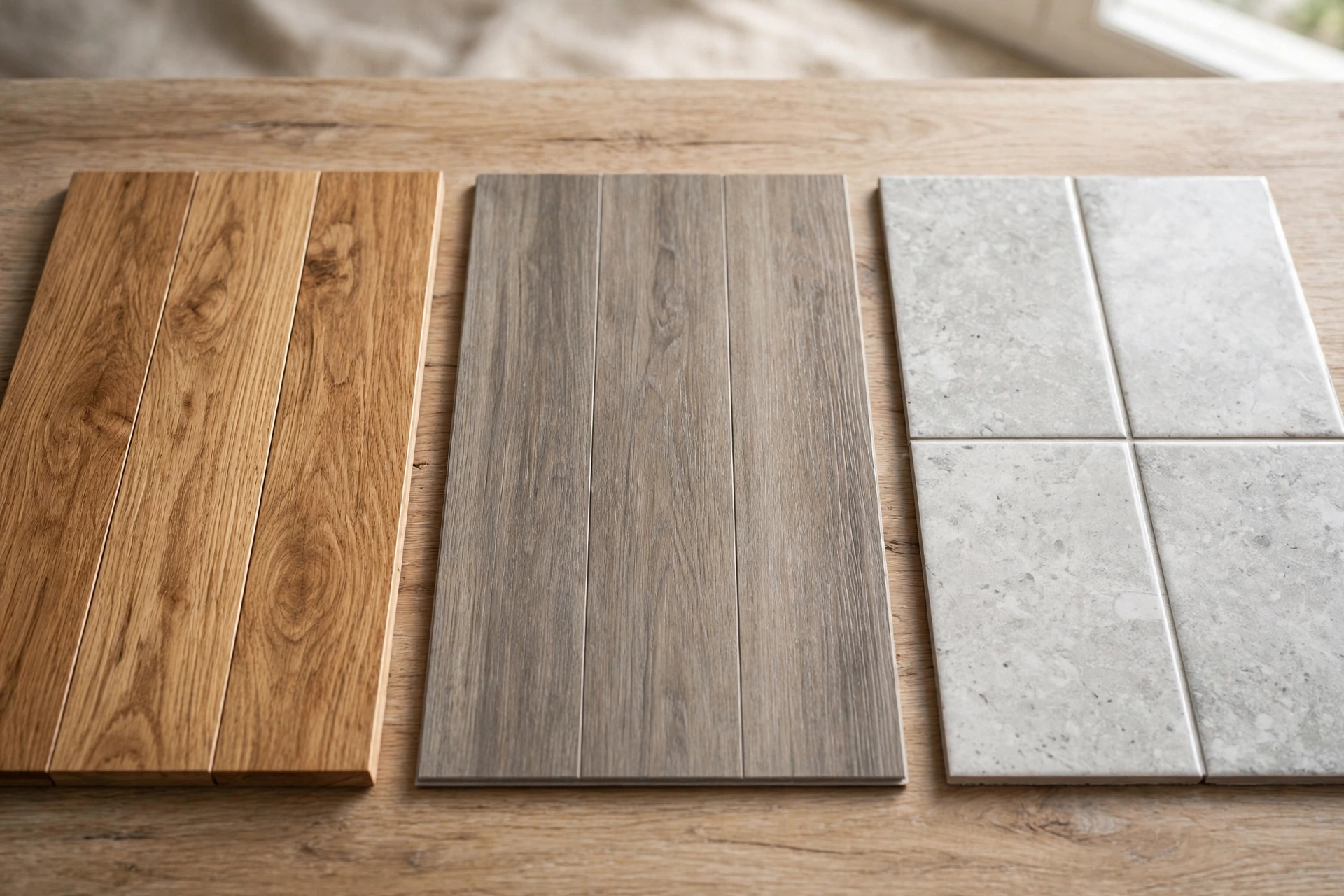
Hardwood: The Classic That Holds Value
Nothing beats real wood for looks. That’s not nostalgia talking — it’s a century of evidence. Hardwood floors age beautifully, they can be refinished multiple times, and real estate agents consistently say they’re the one flooring choice that genuinely adds resale value.
Solid hardwood is exactly what it sounds like: planks milled from a single piece of wood, usually 3/4 inch thick. Because it’s solid all the way through, it can be sanded and refinished four or five times over its life. A well-kept solid oak floor can last a hundred years — there are floors from the 1920s still going strong.
The trade-off is moisture sensitivity. Solid wood expands and contracts with humidity changes. In a dry winter it can gap slightly; in a humid summer it swells. That’s normal, but it means solid hardwood is a poor choice for basements, bathrooms, or anywhere water sits.
Engineered hardwood solves most of that. It’s a real wood veneer — actual oak, walnut, hickory — bonded over layers of plywood. Once installed, it looks identical to solid. But the plywood core barely moves with humidity, so it handles basements, concrete slabs, and temperature swings far better. The catch: the veneer is thin, so you can only refinish it once or twice. For most homeowners, that’s plenty.
Costs: expect $8–$15 per square foot installed for solid hardwood, $6–$12 for engineered. It’s the priciest category on this list, and the price reflects both the material and the skilled labor to install it properly.
My honest take: if your budget allows and you’re not putting it somewhere wet, hardwood is still the best floor you can buy. Nothing synthetic has quite matched the feel underfoot or the way it ages. It’s a 50-year decision, so make it count.
Related: Hardwood Flooring Guide — solid vs engineered, wood species, finishes, costs, and maintenance in full detail.
Vinyl: The Comeback Kid
Forget everything you think you know about vinyl flooring. Those peel-and-stick squares from the ’90s? Ancient history. Modern luxury vinyl plank (LVP) and luxury vinyl tile (LVT) are the fastest-growing flooring category in the country, and the growth isn’t slowing down.
Here’s why: LVP clicks together like laminate, but it’s made from PVC — which makes it genuinely waterproof, not just water-resistant. Drop a glass of water, leave it overnight, mop it up in the morning: no damage. For households with kids, dogs, or general chaos, that’s a game-changer.
The visuals have caught up too. High-end LVP convincingly mimics oak, walnut, even stone (that’s the LVT side). Embossed grain textures, beveled edges, varied plank widths — from standing height, good vinyl fools almost everyone.
Then there’s SPC (stone plastic composite) — the rigid-core upgrade. It has a limestone-based core that makes it denser, more dent-resistant, and more dimensionally stable than standard vinyl. If you’re choosing vinyl, SPC is worth the small premium.
Costs: $3–$7 per square foot installed, depending on thickness and wear layer.
The honest caveats: it’s still plastic, and it won’t add resale value the way hardwood does. Cheap thin vinyl (the bargain stuff) can look flat and artificial — the wear layer matters enormously. For busy households, don’t go below a 20-mil wear layer; 12-mil is fine for low-traffic bedrooms.
My honest take: vinyl is the rational choice for most families right now. It does 80% of what hardwood does at 40% of the price, and it survives things that would destroy real wood. The stigma is outdated.
Related: Vinyl Flooring Guide — LVP vs LVT vs SPC, waterproofing explained, costs, installation, and what to actually buy.
Laminate: The Budget Wood Look
Laminate is the original wood impersonator — a photographic image of wood grain fused to a fiberboard (HDF) core, topped with a protective wear layer. It’s been around since the 1990s, and it remains the cheapest way to get a convincing wood look: $2–$5 per square foot installed.
Modern laminate looks dramatically better than the shiny, obviously-fake stuff from twenty years ago. Registered embossing (texture that follows the grain pattern), beveled edges, wide planks — the good stuff genuinely fools people. I’ve watched homeowners tap it and ask “is this real wood?” more than once.
The weakness is water. Standard laminate’s fiberboard core swells and ruins if water gets into the seams — and seams are everywhere. A spilled glass wiped up quickly? Fine. A slow dishwasher leak? That’s a floor replacement. Keep standard laminate out of bathrooms, be cautious in kitchens, and wipe spills promptly.
Costs: $2–$5 per square foot installed. Often the cheapest hard-surface option.
My honest take: laminate is the best value in flooring when water isn’t a concern. For bedrooms, living rooms, and hallways on a budget, it’s genuinely hard to beat. Just respect its one big weakness and you’ll be happy.
Tile: The Wet-Area Champion
Ceramic and porcelain tile is the undisputed king of wet areas — bathrooms, kitchens, laundry rooms, mudrooms. It’s waterproof by nature, nearly indestructible, and available in every style imaginable, including wood-look planks so convincing they’ve fooled contractors.
Porcelain vs ceramic: porcelain is denser, fired at higher temperatures, and tougher. For floors, porcelain is the pick — it handles heavy traffic and resists chipping better. Ceramic is fine for walls and light-use floors, and usually cheaper.
Costs: $5–$12 per square foot installed, climbing higher for large-format tiles, intricate patterns, or premium porcelain.
The downsides are comfort-related, not durability-related. Tile is cold and hard underfoot — wonderful in a warm climate or over radiant heating, less wonderful for a bedroom where you pad around barefoot at 6 AM. Dropped dishes don’t survive. And grout lines need periodic sealing and cleaning (epoxy grout largely solves the staining issue, worth the upgrade).
My honest take: for any room that gets genuinely wet, tile is still the gold standard. Nothing else matches its combination of waterproofing and longevity. Just budget for the labor — tile installation is skilled work, and the labor often costs more than the tile itself.
Linoleum: The Natural One Everyone Forgets
First, the clarification everyone needs: linoleum is not vinyl. They’re completely different materials that happen to come in similar formats. Linoleum is made from linseed oil, wood flour, cork dust, and jute — all natural, all renewable. It’s been around since the 1860s. Your grandmother’s kitchen almost certainly had it.
And it’s genuinely excellent stuff. Linoleum is naturally antimicrobial (the linseed oil inhibits bacterial growth), biodegradable, and available in rich, saturated colors that vinyl can’t quite match. It lasts 25–40 years with proper care — one of the longest lifespans of any resilient flooring.
Costs: $4–$8 per square foot installed.
Why isn’t it more popular? Mostly a marketing story — vinyl’s manufacturers outspent and out-distributed linoleum for decades, and the names got confused in consumers’ minds. There’s also a break-in period: new linoleum has a slight linseed-oil smell and an amber cast (“ambering”) that fades over weeks.
My honest take: linoleum deserves a renaissance. For kitchens, playrooms, and anyone prioritizing natural materials, it’s one of the best floors you can buy — durable, healthy, and genuinely beautiful in the right colors.
Related: Linoleum Flooring Guide — what it actually is, linoleum vs vinyl, pros and cons, costs, and best rooms.
Carpet: The Comfort Pick
Carpet is the outlier in this list — soft, warm, quiet, and the cheapest option at $2–$6 per square foot installed. For bedrooms, it’s still the most comfortable thing you can put on a floor. It insulates against cold, deadens sound (huge for upstairs rooms), and there’s nothing nicer under bare feet on a winter morning.
The trade-offs are well documented: it stains, it traps allergens and dust, and it wears out faster than any hard surface — 8 to 15 years is typical, less with pets. And once it’s worn, there’s no refinishing it. Replacement is the only option.
Where it still makes sense: bedrooms, hands down. Some people love it in living rooms too, though that’s increasingly rare. Anywhere else — hallways, stairs are debatable, kitchens and bathrooms are a hard no.
My honest take: carpet is a comfort choice, not an investment choice. If you love the feel and you’re okay replacing it in a decade, bedrooms are its natural habitat. Everywhere else, hard surfaces win on durability, cleanliness, and resale.
Installation Methods Compared
How a floor goes in affects cost, DIY-friendliness, and even performance. The main methods:
Nail-down / staple-down: traditional for solid hardwood. Fasteners go through the tongue into the subfloor. Secure and permanent — but requires a wood subfloor and professional tools.
Glue-down: common for engineered wood, LVT, and commercial vinyl. Adhesive bonds the floor to the subfloor. Very stable, great for high-traffic areas, but messy and unforgiving — mistakes are permanent.
Click-lock (floating): the DIY favorite. Planks lock together edge-to-edge and “float” over an underlayment without attaching to the subfloor. Used by LVP, laminate, and some engineered wood. Fast, forgiving, and removable.
Loose-lay / peel-and-stick: the simplest. Heavy vinyl planks that grip by weight and friction, or tiles with adhesive backing. Genuinely doable in a weekend with basic tools.
Mortar-set: tile’s method. Thinset mortar bonds tile to a prepared subfloor. Skilled work — lippage (uneven edges) and cracked grout are what separate good tile setters from bad ones.
Maintenance: What Each Floor Actually Needs
Hardwood: sweep or vacuum regularly, damp-mop with a wood-specific cleaner (never soak it), recoat the finish every 3–5 years in high-traffic areas, refinish when wear shows through.
Vinyl: the easiest — sweep and damp-mop with a pH-neutral cleaner. Avoid abrasive scrubbers and steam mops (heat can damage the wear layer on cheaper products).
Laminate: dry maintenance mostly — sweep, vacuum, barely-damp mop. Never wet-mop; standing water is the enemy.
Tile: sweep and mop; the tile itself is nearly maintenance-free. Grout is the chore — seal it annually (unless epoxy), scrub when dingy.
Linoleum: sweep and damp-mop with a neutral cleaner. Needs periodic sealing or waxing depending on the product — check the manufacturer’s guidance.
Carpet: vacuum weekly (twice with pets), professional deep clean annually, spot-treat stains immediately. This is the highest-maintenance floor on the list, no contest.
Head-to-Head: The Numbers
Upfront cost (installed, per sq ft):
- Carpet: $2–$6
- Laminate: $2–$5
- Vinyl (LVP): $3–$7
- Linoleum: $4–$8
- Tile: $5–$12
- Hardwood: $6–$15
Typical lifespan:
- Carpet: 8–15 years
- Laminate: 15–25 years
- Vinyl: 15–25 years
- Linoleum: 25–40 years
- Tile: 30–50+ years
- Hardwood: 50–100 years (refinishable)
Water resistance:
- Waterproof: vinyl, tile
- Water-resistant: sealed linoleum, engineered hardwood (surface only)
- Keep dry: solid hardwood, standard laminate, carpet
How to Choose: Room by Room
Living room: hardwood if the budget allows; LVP or laminate if not. Looks and comfort matter most here — this is the room guests see.
Kitchen: vinyl or tile. Water happens in kitchens — spills, splashes, the slow dishwasher leak you won’t notice for a month. Plan for it.
Bathroom: tile or waterproof vinyl. Non-negotiable. This room gets wet by design.
Bedroom: carpet for comfort, hardwood or LVP for resale value and allergies. Genuinely a lifestyle choice.
Basement: vinyl or tile. Concrete slabs, potential moisture, and temperature swings rule out solid hardwood and standard laminate.
Rental property: LVP, full stop. Durable, waterproof, affordable to replace, and tenants can’t easily destroy it.
Home office: anything comfortable — you’ll be sitting still for hours. Carpet or LVP with a good chair mat.
Frequently Asked Questions
What’s the most popular flooring right now?
Luxury vinyl plank, by a wide margin. It hits the sweet spot — good looks, real waterproofing, reasonable price — that the mass market wants. Hardwood still leads in high-end homes.
What’s the cheapest flooring I can put down?
Peel-and-stick vinyl tiles or budget laminate, both under $2 per square foot for materials. But factor in lifespan: cheap carpet replaced in 8 years costs more over time than mid-range vinyl that lasts 20.
Which flooring adds the most home value?
Solid hardwood, consistently. Real estate data backs this up year after year — it’s the one floor buyers will pay a premium for.
What flooring is best for dogs?
Waterproof LVP or tile. Dogs mean scratches, accidents, and muddy paws — you want something that shrugs all of it off. Avoid solid hardwood (scratches) and carpet (odors).
Can I install flooring myself?
Click-lock LVP, laminate, and peel-and-stick are genuinely DIY-friendly — a weekend project with basic tools. Hardwood, tile, and sheet goods reward professional installation unless you have real experience.
Is laminate or vinyl better?
For most people, vinyl — the waterproofing is the deciding factor. Laminate wins only on upfront price. If the rooms stay dry and budget is tight, laminate is excellent value.
The Bottom Line
There’s no single “best” flooring — there’s only the best flooring for your room, your budget, and your life. A house with kids and big dogs needs different floors than a quiet condo. Start with the room’s moisture exposure, be honest about your budget and your tolerance for maintenance, then pick the best material in that category. Do that, and you’ll end up with floors you’re happy to walk on for decades — instead of floors you’re already planning to replace.