
Here’s a small tragedy that plays out in bathroom showrooms every weekend: someone falls in love with a gorgeous frameless glass shower enclosure, gets it home, and discovers it doesn’t fit their space, their budget, or their life. The glass was beautiful. The planning was not.
A shower enclosure is the structure that contains your shower — walls, panels, doors, the whole assembly. Get it right and your bathroom feels bigger, brighter, and easier to live with. Get it wrong and you’re stuck with a daily annoyance in the most-used room of the house. This guide covers shower enclosures and shower stalls: the types, the glass, the doors, the costs, and how to choose.
Shower Enclosure vs. Shower Stall: What’s the Difference?
People use these terms interchangeably, and most of the time it doesn’t matter — but there is a real distinction.
A shower enclosure generally refers to the glass-and-frame assembly that surrounds a shower area: the panels, the door, the hardware. It’s the “walls” of the shower, sold as a unit or built custom. When someone says “frameless shower enclosure,” they mean the glass structure.
A shower stall usually means the complete standalone unit — base (pan) plus walls, sometimes plus the enclosure. A pre-fab shower stall is the all-in-one box: floor, walls, and often the door, ready to set in place. Think of “stall” as the whole thing and “enclosure” as the glass-and-frame part.
In practice? If you’re shopping, you’ll see both terms on the same products. Just know what you’re actually buying: glass panels alone, or a complete unit with a base.
Related: Shower Pan Guide — the base your enclosure sits on, and why getting the pan right matters first.
Types of Shower Enclosures
Framed Enclosures
The classic: glass panels held in a full aluminum or metal frame, top to bottom, all edges. This is the workhorse of shower enclosures — affordable, sturdy, and available in every size.
Why people choose them: price (often half the cost of frameless), rigidity (the frame does the structural work, so thinner glass is fine), and availability. Every home improvement store stocks framed shower enclosures in standard sizes.
The downside: the frame has tracks and edges where water, soap scum, and mildew collect. More cleaning, more crevices. And visually, the frame breaks up the space — fine in a big bathroom, noticeable in a small one.
Semi-Frameless Enclosures
The middle ground: glass with framing only where structurally needed — usually around the door and along some edges, but not a full perimeter frame. You get most of the clean look of frameless with some of the cost savings of framed.
Best for: people who want the modern look without the frameless price tag. The door typically has a frame while the fixed panels don’t, which is a sensible compromise.
Frameless Glass Enclosures
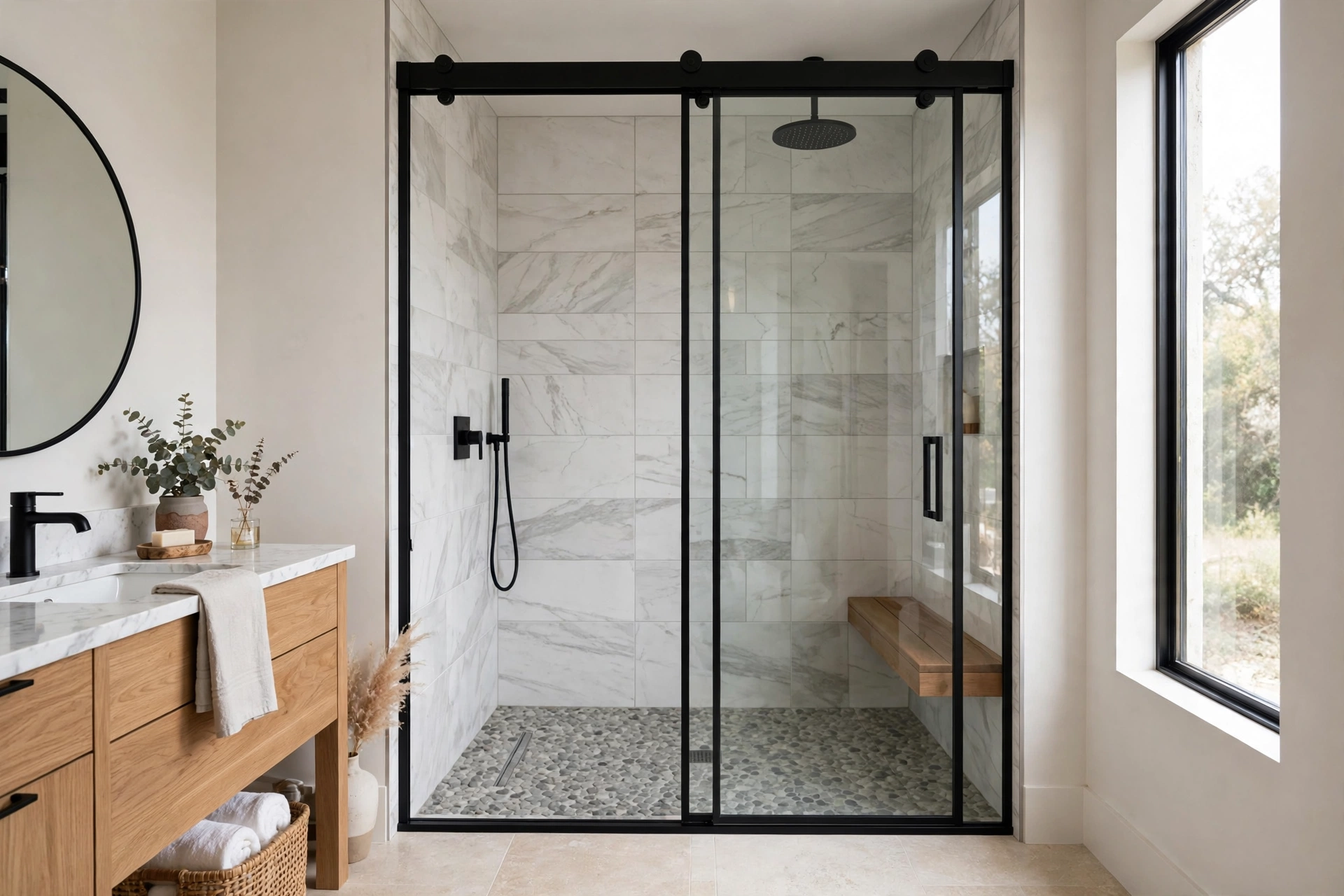
The showpiece: thick tempered glass panels held by minimal hardware — small clips, hinges, a slim U-channel. No frame interrupting the view. This is what makes a bathroom look twice its size.
Why they’re worth it (sometimes): nothing opens up a bathroom like frameless glass. Cleaning is simpler too — no tracks, fewer crevices, just glass. The catch: cost (2–3x a framed enclosure), and installation is less forgiving. The glass is heavy, the measurements have to be exact, and out-of-plumb walls need shimming or custom cuts.
My honest take: frameless is genuinely better-looking and easier to keep clean, but it’s not automatically the right call. In a rental or a kids’ bathroom, a good framed enclosure is the smarter money.
Neo-Angle Enclosures
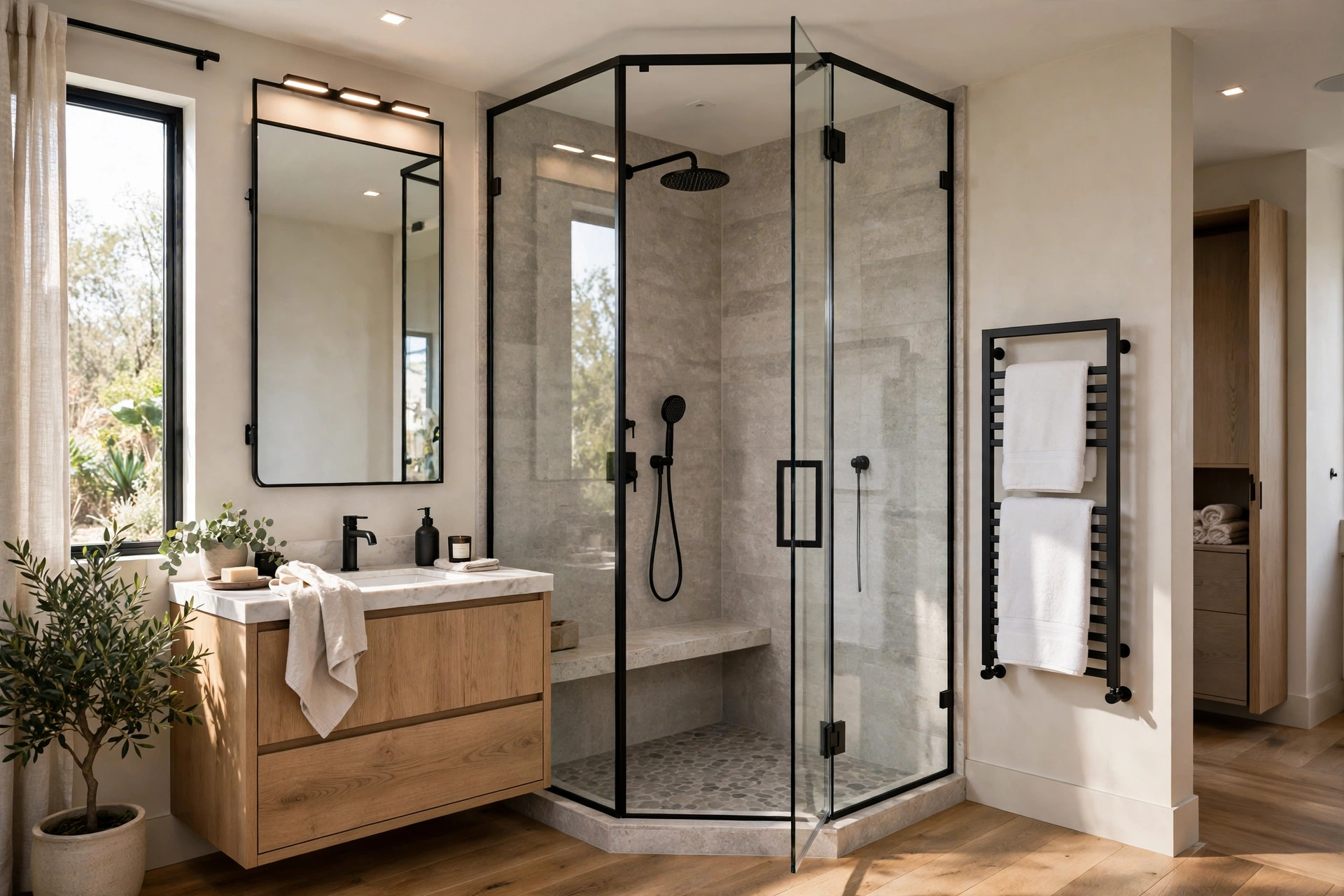
A space-saving shape: instead of a square corner, the enclosure cuts across the corner at a 45-degree angle, creating a diamond-ish footprint. The door sits on the angled front.
Best for: tight bathrooms where a square corner shower would jut into the walking path. A neo-angle shower stall tucks into the corner and keeps the room’s traffic lane clear. Watch out for: the angled door can feel narrow, and replacement parts are less standard than for square enclosures.
Shower Door Types: Sliding vs. Pivot vs. Open
The door is the part you’ll touch twice a day, so it deserves real thought.
Sliding (bypass) doors run on tracks, one panel sliding past the other. Pros: no swing clearance needed — ideal for tight bathrooms where a door can’t open outward. Cons: tracks. Tracks collect everything: soap, hair, mildew. They’re the highest-maintenance door type, full stop.
Pivot (hinged) doors swing open like a regular door. Pros: easy to clean (no tracks), wide entry, and they feel substantial. Cons: they need clearance to swing — typically 24–30 inches of free space in front of the shower. In a small bathroom, that swing zone can collide with the vanity or toilet.
Walk-in open entries have no door at all — just a fixed glass panel with an open side. Pros: zero door maintenance, zero clearance issues, the airiest look. Cons: some splash escapes (manageable with proper panel sizing), and less heat retention — the shower feels draftier without a door closing it in.
Here’s what most guides won’t tell you: the “best” door type is mostly decided by your bathroom’s floor plan, not your taste. Measure your clearance first, then fall in love with a style — not the other way around.
Related: Walk-In Shower Guide — the full breakdown of doorless walk-in designs, kits, and costs.
Glass Thickness: 3/8″ vs. 1/2″ — What Actually Matters
Shower glass comes in a few thicknesses, and the marketing makes it sound more dramatic than it is.
1/4″ (6mm) is standard for framed enclosures — the frame provides the rigidity, so thinner glass is fine. Don’t pay for thicker glass in a fully framed unit; you won’t feel the difference.
3/8″ (10mm) is the frameless standard. Heavy enough to feel solid, rigid enough to stand with minimal hardware. For most frameless shower enclosures, 3/8″ is the sweet spot — and what most installers recommend.
1/2″ (12mm) is the premium option: noticeably heavier, more substantial feel, marginally better sound dampening. Honestly? For most bathrooms, it’s luxury rather than necessity. It also costs more and needs beefier hardware and more careful installation because of the weight.
All shower glass should be tempered — it’s a safety requirement, not an upgrade. Tempered glass shatters into small dull cubes instead of dangerous shards. If anyone tries to sell you non-tempered glass for a shower enclosure, walk away.
One more thing: glass coatings. Factory-applied protective coatings (the various “easy-clean” treatments) genuinely help — water sheets off instead of spotting, and cleaning takes half the effort. Worth the upcharge if you hate squeegeeing.
The Squeegee Habit (Cleaning Glass Enclosures)
Let me save you years of frustration: hard water spots on shower glass are not a cleaning problem, they’re a prevention problem. Once mineral deposits etch into glass, they’re miserable to remove. The fix costs $8 and thirty seconds.
Squeegee the glass after every shower. That’s it. That’s the whole secret. A quick pass takes less time than reading this paragraph, and it prevents 90% of water-spot buildup. Keep the squeegee hanging in the shower so there’s no friction to the habit.
For weekly cleaning: a mix of white vinegar and water cuts through light mineral film, or use a dedicated glass shower cleaner. Avoid abrasive scrubbers on coated glass — they’ll strip the protective coating you paid extra for. And skip the harsh limescale removers as a routine cleaner; they’re for rescue missions, not maintenance.
Framed enclosures need track attention: pull the sliding panels periodically and clean the tracks with an old toothbrush and vinegar. It’s nobody’s favorite job, which is exactly why pivot doors and frameless designs have a real-world cleanliness advantage.
Measuring Your Space (Do This Before Shopping)
Enclosure shopping without measurements is how you end up with a beautiful glass box that doesn’t fit. Here’s what to measure:
- The opening width — wall to wall (or wall to curb edge) at the top, middle, and bottom. Walls are rarely perfectly plumb; use the smallest measurement.
- The height — from the top of the curb or pan to where you want the glass to end. Standard is 72–76 inches, but measure anyway.
- Door swing clearance — for pivot doors, measure the arc: is there 24–30 inches of clear space? Open an imaginary door and check for collisions with the toilet, vanity, or entry door.
- The pan or base dimensions — the enclosure must match the base exactly. A 60-inch enclosure on a 58-inch pan is a leak waiting to happen.
Out-of-plumb walls are the silent killer of enclosure installs. If your walls lean more than about a quarter inch over the glass height, a stock enclosure won’t sit right — you’ll need shimming, a filler strip, or a custom-cut unit. Check with a level before you buy, not after delivery.
What Do Shower Enclosures Cost?
Realistic US ranges, materials plus typical installation:
- Pre-fab shower stalls (all-in-one units): $500–$1,500 for the unit; $1,000–$2,500 installed. The budget-friendly full replacement.
- Framed glass enclosures: $400–$1,200 for the enclosure; $800–$2,000 installed.
- Semi-frameless enclosures: $800–$2,000 for the enclosure; $1,500–$3,500 installed.
- Frameless custom enclosures: $1,500–$4,000+ for glass and hardware; $2,500–$5,000+ installed. Large or unusually shaped: $3,000+ easily.
- Neo-angle enclosures: $600–$1,800 depending on framed vs frameless.
Installation labor varies a lot by market, but glass work isn’t where you want the cheapest bid. A poorly installed frameless panel is a safety issue, not just an aesthetic one.
Which Enclosure Is Best for You?
Quick scenarios, no fluff:
Small bathroom, tight budget → framed sliding enclosure or a pre-fab shower stall. The sliding door needs no swing clearance, and framed keeps costs down.
Small bathroom, flexible budget → frameless pivot or a neo-angle enclosure. The glass visually doubles the space, and neo-angle saves floor area.
Master bath remodel → frameless, 3/8″ glass, pivot door or walk-in open entry. This is where the investment shows.
Kids’ bathroom → framed. It’ll take abuse, parts are cheap, and you’re not crying over a scratched $3,000 glass panel.
Rental property → pre-fab shower stall or basic framed enclosure. Durable, replaceable, and no tenant is squeegeeing your frameless glass.
Aging in place → walk-in open entry (no door to wrestle) or a wide pivot door, with a low or curbless base. Pair with grab bars and a bench.
Related: Shower Wall Panels Guide — what goes on the walls inside your enclosure, from acrylic to solid surface.
Frequently Asked Questions
What is a shower enclosure with shower?
It’s the glass-and-frame assembly (panels + door) that surrounds a shower area, sometimes sold together with the shower base as a complete unit. “Shower enclosure” usually means the glass structure; “shower stall” usually means the full unit including the base.
Is 3/8″ or 1/2″ glass better for a shower enclosure?
For most frameless enclosures, 3/8″ is the sweet spot — solid, rigid, and what installers recommend. 1/2″ feels more substantial but costs more and needs heavier hardware. In a framed enclosure, glass thickness barely matters since the frame does the structural work.
Are frameless shower enclosures hard to clean?
They’re actually easier than framed — no tracks or frame edges collecting grime. The maintenance is just the glass itself: squeegee after each shower and you’ll rarely need more than a weekly wipe-down.
Can I install a shower enclosure myself?
Framed enclosures and pre-fab stalls are doable DIY with basic tools and a helper (glass is heavy and awkward). Frameless glass — especially custom — is best left to pros: the measurements are unforgiving and a dropped panel is dangerous and expensive.
How long does a shower enclosure last?
The glass itself lasts decades. What fails first: door hardware and hinges (10–15 years), seals and sweeps (replace every few years), and protective coatings (5–10 years depending on the product). Framed enclosures may need track or seal replacement sooner.
The Bottom Line
Pick your enclosure for your bathroom’s reality — its size, your budget, who’s using it — not for the showroom fantasy. Measure twice, squeegee daily, and remember that the fanciest glass in the world can’t fix a bad floor plan. A $600 framed enclosure that fits perfectly beats a $3,000 frameless one that doesn’t, every single time.
Pingback: Walk-In Shower Guide: Ideas, Kits & Costs - Seen Scale
Pingback: Corner Showers: Big Ideas for Small Bathrooms
Pingback: Corner Showers: Big Ideas for Small Bathrooms - Seen Scale